
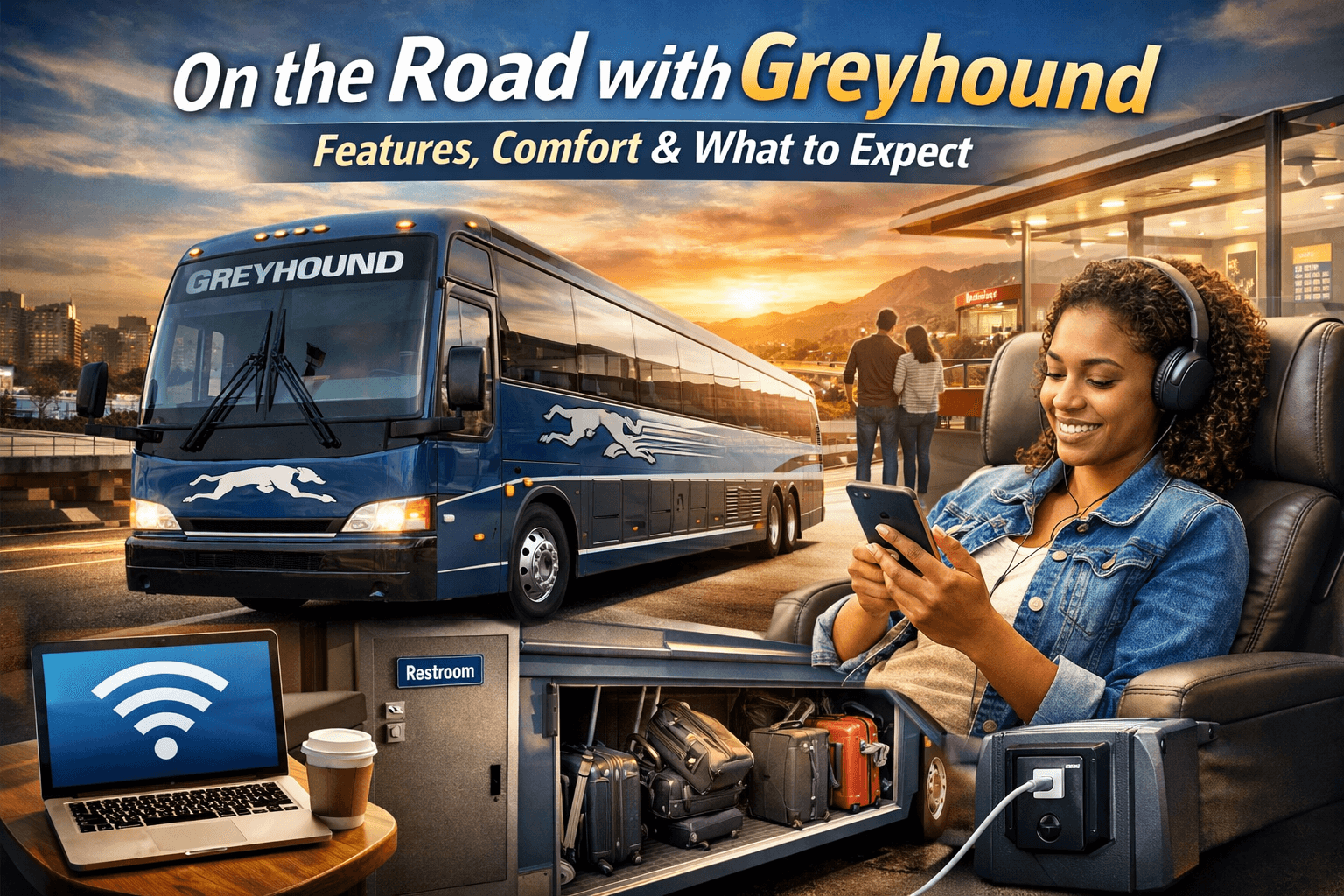
Complete Guide to Greyhound Features
Feb 06 2026
There is a particular kind of romance in watching America unspool through a tinted bus window — cornfields flattening into mesa, city skylines dissolving into prairie. I have clocked tens of thousands of miles on Greyhound over a decade of travel writing, and the question I get asked most often is not about the destinations. It is about the bus itself. Does Greyhound have Wi-Fi? Are the seats comfortable enough for an overnight trip? What can you actually bring on board? In this guide, I am going to answer every single one of those questions — and a few you haven't thought to ask yet.
An Overview of Greyhound Bus Features
Before we get granular, here is a snapshot of what the modern Greyhound bus offers. Most routes, especially those classified as Greyhound Express services, operate on newer coaches equipped with the full suite of amenities. Local and regional routes may run on older equipment where some features are absent, so it is always worth checking your specific route before booking.
Free Wi-Fi: Available on most routes; speeds sufficient for browsing and streaming in low quality.
Power Outlets: 110V outlets and USB ports at most seats on newer fleet vehicles.
Reclining Seats: Adjustable backrest, armrests, and fold-out tray tables on Express coaches.
Climate Control: Individual air vents at every seat. A light jacket is recommended year-round.
Onboard Restroom: Rear-mounted restroom on all long-distance coaches. Kept clean on most routes.
Generous Luggage: One carry-on plus one free checked bag. Overhead racks and under-bus storage.
Click here to check Greyhound ticket prices
Greyhound Bus Seating: Comfort, Legroom & Layout
The seats are the make-or-break feature for any long bus journey, and here Greyhound has made real strides. On Express routes operating newer Prevost or MCI motorcoaches, seats are arranged in a 2-2 configuration with approximately 31 to 34 inches of pitch, comparable to most economy airline seats, and with one significant advantage: you can actually get up and walk around.
How much legroom does Greyhound give you?
Legroom on Greyhound varies by coach type. Newer vehicles on the Express network average 32–34 inches of seat pitch, which is on the generous side for ground transportation. The seats recline by a meaningful amount, typically 8 to 10 degrees, without unduly impinging on the passenger behind you. Headrests are adjustable on newer coaches, and the upholstery, while not plush, is supportive enough for an 8-hour haul if you come prepared with a travel pillow.
Can you choose your seat on Greyhound?
Since the FlixBus integration, Greyhound has moved toward reserved seating on many routes, meaning you can select your seat at the time of booking. Seat selection is free on most tickets. If you are travelling solo and want guaranteed privacy, booking a window seat in a row with an unoccupied aisle seat is a reasonable strategy — though it is never guaranteed on busy intercity routes. The coveted front rows offer a panoramic view and tend to fill first.
Wi-Fi, Power Outlets & Connectivity on Greyhound
This is the section most modern travellers jump to, and rightfully so. The ability to work, stream, or simply stay connected on a long journey transforms the experience from an endurance test to a productive retreat.
Does Greyhound have Wi-Fi in 2026?
Yes, free onboard Wi-Fi is available on the vast majority of Greyhound routes, particularly on Express services and the newer FlixBus-operated coaches. The network is provided via cellular aggregation, which means signal quality correlates with the coverage of your surroundings. Across densely populated corridors like New York to Washington or Los Angeles to San Francisco, the connection is reliably strong enough for video calls and light streaming. On rural stretches through Wyoming or Montana, expect the signal to dip.
The practical advice I give every first-time Greyhound rider is to download your entertainment before you board, podcasts, films, and playlist downloads. Use the Wi-Fi as a pleasant bonus rather than a guaranteed utility, and you will never be disappointed.
Check routes and book your Greyhound Ticket now.
Power outlets: charging your devices en route
Most newer Greyhound coaches feature 110V power outlets below or beside each seat, often paired with a USB-A port. This is a genuine differentiator from budget air travel, no hunting for a gate outlet, no anxious battery-watching. For overnight trips, this means you can plug in your phone or laptop and arrive with a full charge. On older vehicles still in rotation, power may only be available at alternating seat rows, so an extension cable or multi-port USB block is worth keeping in your carry-on.
Insider Tip
Bring a small USB-C power brick as backup. On older coaches or extremely busy routes, outlet availability can be inconsistent. A charged laptop sleeve and noise-cancelling earbuds will transform any Greyhound trip into a genuinely productive travel day.
Click here to book your Greyhound tickets stress-free.
Greyhound Luggage Policy: What You Can Bring
One of Greyhound's most enduring advantages over budget airlines is its generous luggage policy. At a time when carriers charge $35 or more for a single checked bag, Greyhound's allowance feels almost nostalgically generous.
Greyhound's standard baggage allowance
Each ticket includes one free carry-on bag weighing up to 25 pounds, stored in the overhead compartment, plus one free checked bag weighing up to 50 pounds, stored in the underbus luggage hold. Additional checked bags can be added for a fee of around $20 each. There is no fee for items like a personal backpack or handbag that fits under your seat; this is treated as a personal item and not counted against your allowance.
What can you bring on Greyhound?
Standard personal items, food and non-alcoholic beverages, car seats and strollers (checked free of charge), and most sports equipment with advance notice are all permitted. Bicycles, surfboards, and oversized items must be boxed and may require a special oversized baggage fee. Firearms, illegal substances, and hazardous materials are, naturally, prohibited. Service animals are welcome at no extra charge with appropriate documentation.
Greyhound Express vs Standard Routes: What's the Difference?
Not all Greyhound services are created equal, and understanding the distinction between Express and standard routes is crucial to setting your expectations correctly.
Feature | Greyhound Express | Standard Route |
Fewer stops | ✔ Direct/limited | ✘ Multiple stops |
Free Wi-Fi | ✔ Reliable | Varies by coach |
Power outlets | ✔ All seats | Varies |
Reserved seating | ✔ Included | First-come basis |
Newer fleet | ✔ Primarily | Mixed |
Ticket price | Slightly higher | ✔ Cheaper |
Journey time | ✔ Faster | Longer |
The Express option is almost always worth the modest price premium for journeys over four hours. The combination of fewer stops, more reliable connectivity, and guaranteed seating makes a significant difference in comfort and arrival time.
Safety & Accessibility Features on Greyhound
Is Greyhound bus safe to travel on?
Bus travel remains one of the statistically safest modes of transportation in North America. Greyhound coaches are subject to federal Department of Transportation safety standards, mandatory driver hours-of-service regulations, and regular mechanical inspections. All drivers must hold a Commercial Driver's License (CDL) with a passenger vehicle endorsement. Since the FlixBus acquisition, there has been a concerted push toward newer, better-maintained fleets, which has improved both the safety and reliability record of services on major corridors.
Accessibility for passengers with disabilities
Greyhound is required to comply with the Americans with Disabilities Act (ADA). All terminals and buses are equipped with wheelchair lifts or ramps, priority seating for passengers with mobility impairments, and trained staff assistance upon request. Passengers with disabilities are encouraged to call ahead or note their needs during booking to ensure seamless boarding. Service animals travel free in the cabin, and passengers requiring personal care attendants may bring one attendant at no additional fare on many routes.
Accessibility Note
If you require wheelchair lift access or any special boarding assistance, call Greyhound's accessibility line at least 48 hours before departure. Pre-notification dramatically improves the experience and ensures the correct equipment is ready at your departure terminal.
Book your next bus ticket with Greyhound.
Taking an Overnight Greyhound: What to Expect
The overnight Greyhound journey is something of an American institution — a way to cover enormous distances while sleeping, arriving at your destination at dawn with a story to tell. It is also, I will be honest, an experience that rewards preparation.
Seats do recline, but they do not fold flat. You will want a neck pillow, a light blanket or travel wrap, and an eye mask. The onboard climate control tends toward the cool side. Greyhound drivers frequently run the air conditioning aggressively even in winter, so dress in layers and keep a sweater accessible, not buried in the overhead bin. The onboard restroom is available throughout the journey, which removes one of the more stressful logistics of long-haul surface travel.
The social dimension of overnight bus travel is underrated. There is a gentle communal quality to sharing a dark coach with strangers, the highway lights sweeping through at intervals, a drowsy quiet punctuated by the hiss of air brakes at a rest stop. More than once, I have arrived somewhere having exchanged the most unexpectedly honest conversations with a fellow passenger — the particular candour that distance and anonymity permit.
Also Read: How to Book Greyhound Bus Tickets Step by Step Guide
Frequently Asked Questions
Does Greyhound have Wi-Fi on all buses?
Wi-Fi is available on most Greyhound routes, especially Express services. Coverage quality depends on the cellular network along your route. Rural corridors may experience intermittent connectivity.
Does Greyhound have power outlets at every seat?
Newer Express coaches have 110V outlets and USB ports at each seat. Older coaches in the fleet may have outlets at alternating rows. Bringing a portable power bank is a reliable backup strategy.
Can you eat and drink on a Greyhound bus?
Yes, passengers are welcome to bring and consume their own food and non-alcoholic beverages. Alcohol is not permitted. Greyhound buses do not have a food or drink service onboard, so stocking up before boarding is advisable for long routes.
How early should you arrive at a Greyhound terminal?
Greyhound recommends arriving at least 30 minutes before departure for ticketed passengers. If you are checking baggage, arriving 45 minutes early gives you comfortable time to check bags, use the terminal facilities, and board without rushing.
Is Greyhound cheaper than flying?
For many short-to-medium intercity routes, Greyhound is substantially cheaper than flying — particularly when you factor in checked baggage fees, airport transport costs, and security time. On corridors under 400 miles, the time difference is often smaller than it appears once airport overhead is counted.
Final Verdict: Is Greyhound Worth It in 2026?
Greyhound is a considerably better product than its reputation from a decade ago might suggest. The core amenities, free Wi-Fi, power outlets, reclining seats, an onboard restroom, and generous luggage allowance, hold up favourably against budget air travel, particularly once you account for the terminal experience and the environmental cost of flying. The Express network delivers fast, comfortable city-to-city travel that punches well above its price point.
Where Greyhound still asks for patience is in the variability of its fleet and the quality of some of its terminals. Not every coach is a new Prevost. Not every station is a model of efficiency. But if you approach it as a traveller rather than a commuter, with snacks packed, earbuds charged, and a genuine curiosity about the American landscape scrolling past your window, Greyhound delivers something that no airline can: the country itself, at ground level, at a human pace.
Click here to book an express route, grab a window seat, and let the miles do their work.