
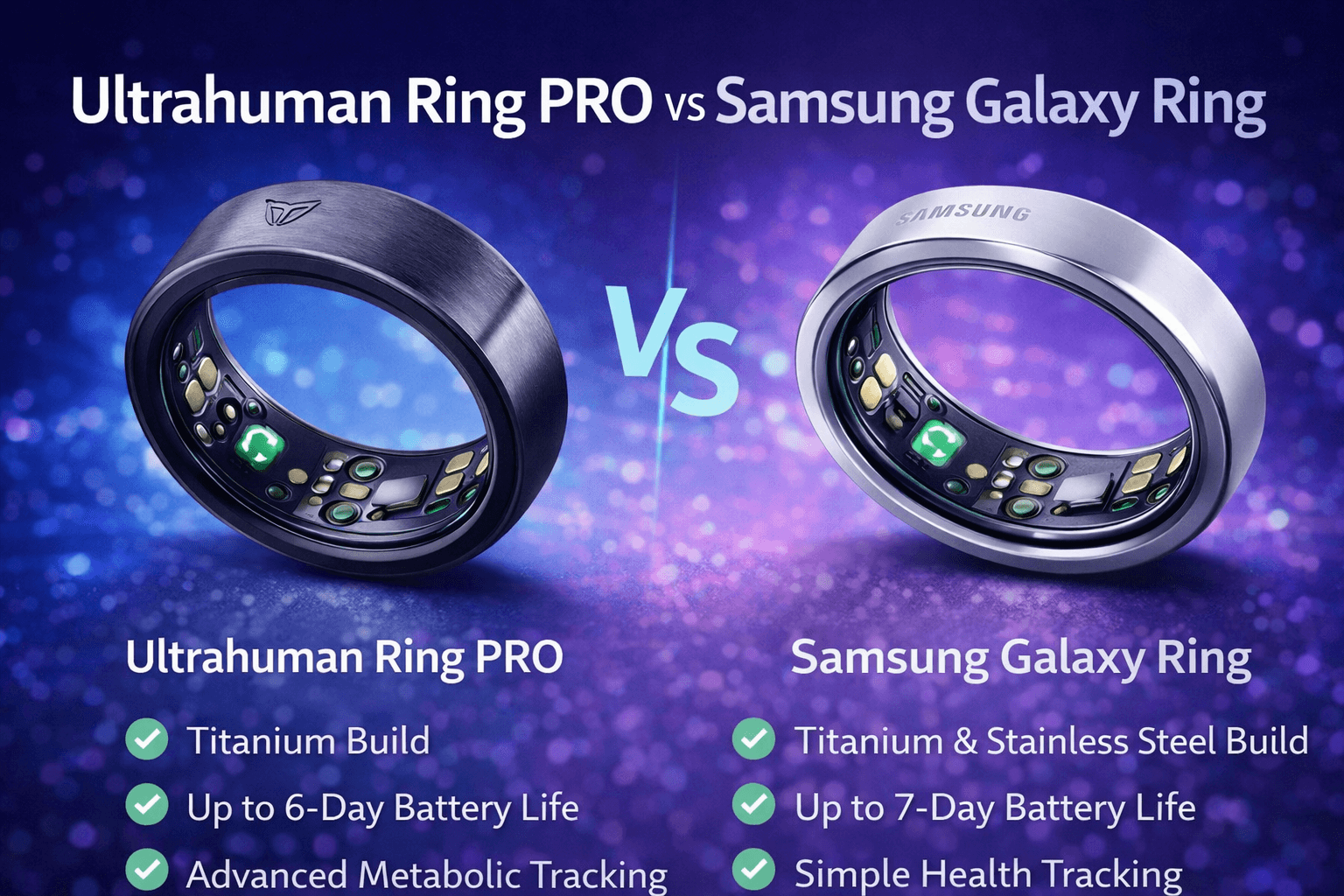
Ultrahuman Ring PRO vs Samsung Galaxy Ring
Jan 28 2026
Verdict: Samsung built a solid first-generation ring with seamless Galaxy integration. Ultrahuman built a third-generation ring with an entire health ecosystem behind it. For pure health tracking depth, the PRO wins. For Galaxy phone owners who want a dead-simple setup, Samsung wins.
Two smart rings. No subscriptions. That alone makes this comparison interesting, because both Ultrahuman and Samsung have rejected the recurring revenue model that Oura, Whoop, and most competitors rely on. You pay once, you get everything. But "everything" means very different things for these two products. I wore both simultaneously for 30 days, one on each hand, tracking the same sleep, the same workouts, the same recovery. Here's where they agree, where they diverge, and which one earns permanent finger space.
Hardware Head-to-Head
Spec | Ultrahuman Ring PRO | Samsung Galaxy Ring |
Material | Titanium unibody | Titanium |
Weight | 4-6g (varies by size) | 2.3-3.0g (varies by size) |
Thickness | 2.65mm | 2.6mm |
Battery Life | 12-15 days | 5-7 days |
Charging | PRO Case (45 days), UltraSnap magnetic | Charging case, contact-based |
Processor | Dual-core with ML | Single-core |
On-Device Storage | 250 days | Limited |
Water Resistance | Shower/pool safe | IP68 + 10ATM |
Sizes | 5-14 | 5-15 |
Colors | 4 finishes | 3 finishes |
Price | $479 (with PRO Case) | $399 |
Samsung is lighter. That's its single hardware advantage. At 2.3 grams for the smallest size, the Galaxy Ring genuinely disappears on your finger. The PRO is heavier but not uncomfortably so.
Battery life isn't close. Samsung manages 5-7 days in practice (Samsung's claim), while the PRO delivers 12-15 days. With the PRO Charging Case, you're looking at over a month without plugging into a wall outlet. Samsung's charging case is functional but doesn't store data or extend battery life the same way. Water resistance is stronger on the Samsung side, with 10ATM certification supporting deeper submersion. For casual swimmers, both are fine. For divers or water sports athletes, Samsung has the edge.
Health Tracking: Where the Rings Diverge
Both rings track sleep stages, heart rate, HRV, skin temperature, and activity. Both assign daily readiness or energy scores. The foundations are similar. The depth is not.
Sleep tracking: I compared nightly reports across 30 nights. Both rings agreed on total sleep time within 10-15 minutes on most nights. Where they disagreed was deep sleep and REM detection. The PRO's redesigned PPG sensor produced more consistent deep sleep readings that better matched how I felt the next morning. Samsung's Galaxy Ring occasionally overestimated deep sleep on nights where I subjectively slept poorly.
HRV: The PRO captures HRV more frequently during sleep and provides more granular trend analysis. Samsung shows a daily HRV number in Samsung Health. Ultrahuman shows hourly HRV curves, baseline trends, and contextual factors affecting variability.
Activity tracking: Samsung wins here. Automatic workout detection for walking and running is seamless and integrates with Samsung Health's massive exercise database. Ultrahuman's activity tracking is adequate but less polished. The ring isn't designed to replace a sports watch.
Stress monitoring: Both offer stress scores. Ultrahuman's is more actionable because Jade AI can trigger interventions (breathwork, for example) when stress markers are elevated. Samsung surfaces a number and a recommendation.
The Ecosystem Gap
This is where Ultrahuman pulls decisively ahead.
Samsung Galaxy Ring feeds data into Samsung Health. That's it. A very good app, well-designed, deeply integrated with Galaxy phones. But the data stays in a single lane. Ultrahuman Ring PRO feeds data into an ecosystem that includes M1 CGM glucose monitoring, Blood Vision blood testing (120+ biomarkers), Ultrahuman Home environmental monitoring, Jade AI biointelligence, and PowerPlugs modular health apps. Each additional product makes the ring data more meaningful.
Samsung has no glucose platform. No blood testing service. No home environment monitor. No modular health app system. The Galaxy Ring is excellent at being a ring. Ultrahuman built the ring to be a gateway into a comprehensive health platform. If you want a standalone ring with no additional purchases, both work. If you want a system that grows with your health tracking ambitions, Ultrahuman is the only option.
Click here to buy the Ultrahuman Ring PRO Now!
Phone Compatibility
Here's where Samsung creates a real problem for itself. The Galaxy Ring only works with Samsung phones running Android 11 or higher with Samsung Health installed. If you use an iPhone, a Pixel, or any non-Samsung Android phone, the Galaxy Ring is useless to you.
Ultrahuman works with both iOS and Android. No manufacturer restriction. No ecosystem lock-in. This single limitation disqualifies the Galaxy Ring for a huge percentage of potential buyers. It's a strategic decision by Samsung to drive Galaxy phone loyalty, and it costs them the smart ring market outside their phone customer base.
App Experience
Samsung Health is more polished. Animations are smoother, navigation is intuitive, and the data visualization is best-in-class for a first-party health app. Samsung has been building this app for over a decade. It shows.
Ultrahuman's app is functional and information-dense but less refined visually. Where it wins is data depth. The correlations screen, the glucose overlay, the environmental integration, and Jade AI responses provide analytics that Samsung Health simply doesn't attempt. If you want a beautiful daily summary, Samsung delivers. If you want to understand why your recovery dropped 12 points versus yesterday, Ultrahuman tells you.
Gesture Controls: Samsung's Unique Feature
The Galaxy Ring supports double-pinch gestures for dismissing alarms and triggering photos. It's a small feature, but it's fun and occasionally useful. Ultrahuman has no gesture support. For some users, this is a meaningful differentiator. For health-focused buyers, it's a novelty.
Long-Term Cost
Period | Ultrahuman Ring PRO | Samsung Galaxy Ring |
Purchase | $479 | $399 |
Year 1 total | $479 | $399 |
Year 2 total | $479 | $399 |
Year 3 total | $479 | $399 |
Both are subscription-free, so the upfront price is the only cost. Samsung is $80 cheaper. But if you value the PRO Charging Case (sold separately for $100), the effective ring price is $379, just $20 less than Samsung. Neither charges ongoing fees. Both receive software updates for the foreseeable future.
The Verdict by Use Case
Buy the Ultrahuman Ring PRO if: You want the deepest health tracking ecosystem available. You use an iPhone or non-Samsung Android phone. Battery life matters to you. You're interested in adding glucose monitoring or environmental tracking in the future.
Buy the Samsung Galaxy Ring if: You own a Samsung Galaxy phone and want seamless integration. You value the lightest possible ring. You want gesture controls. You don't need ecosystem depth beyond sleep, heart rate, and activity basics.
FAQ
Can I use both rings simultaneously?
Technically yes (one per hand), but the data doesn't sync between ecosystems.
Which ring is more comfortable for sleeping?
Both are comfortable. Samsung is marginally lighter, but neither disrupts sleep.
Does Samsung plan a Galaxy Ring 2?
A successor is reportedly in development but delayed to late 2026 or 2027 due to an Oura patent dispute.
Can Ultrahuman Ring PRO work with Samsung Health?
Not directly. Ultrahuman syncs with Apple Health and Google Fit, which can bridge some data.
Which ring has better third-party app support?
Samsung integrates with Samsung's own ecosystem. Ultrahuman integrates with Apple Health, Google Fit, Strava, Garmin, Oura, and Fitbit.