
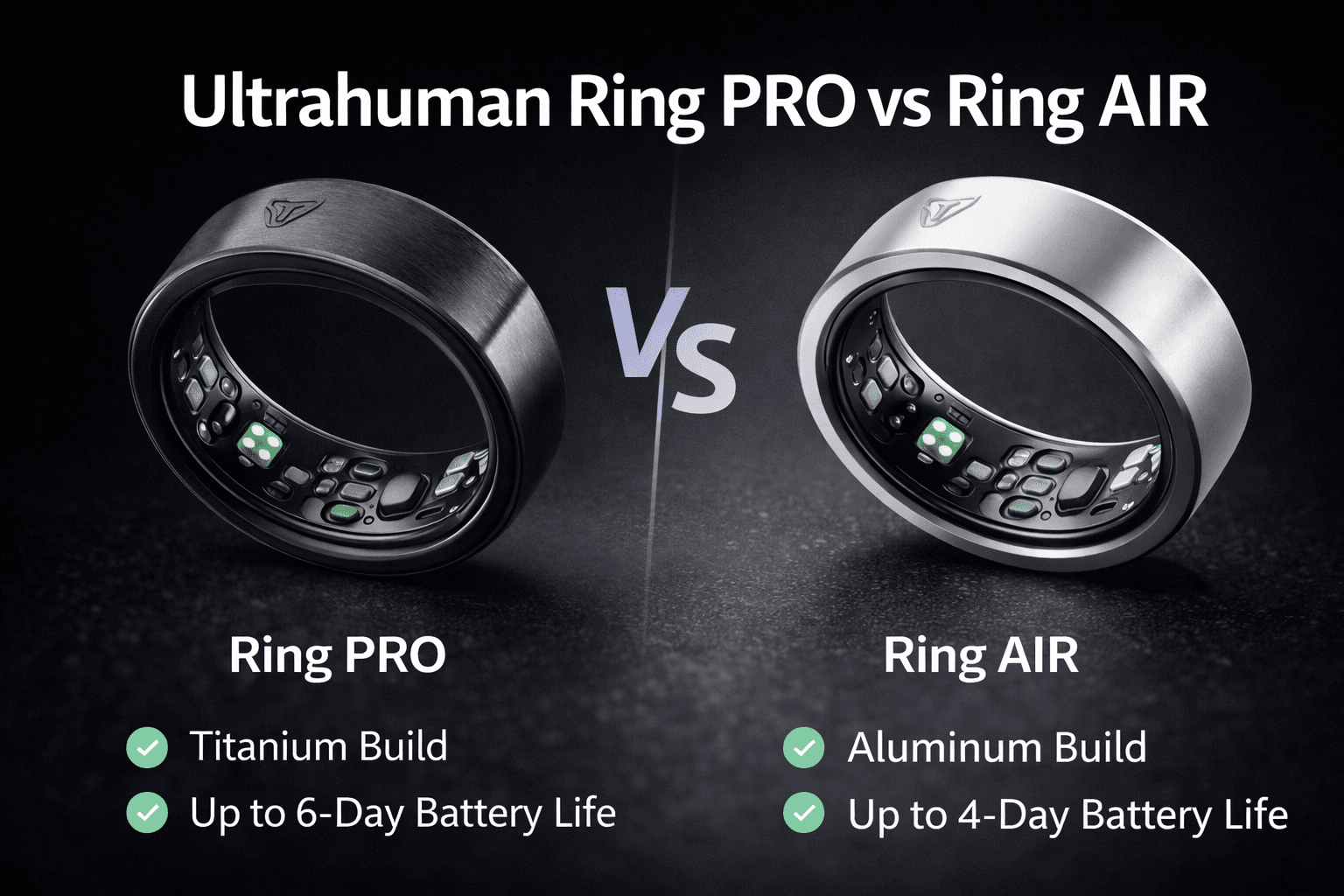
Ultrahuman Ring PRO vs Ring AIR
Mar 05 2026
Author: Kira Estevez | Updated: March 2026 | Reading Time: 9 min
Verdict: If you already own a Ring AIR and battery life frustrates you, the PRO pays for itself in convenience alone. If you're buying your first Ultrahuman ring, skip the AIR entirely.
I wore the Ultrahuman Ring AIR for fourteen months before switching to the Ring PRO in March 2026. The AIR taught me more about my sleep than any device I've tested in eight years of reviewing health tech. But it also taught me what "charging anxiety" feels like when your ring dies at 2am on a Tuesday and you lose an entire night of sleep data.
The PRO fixes that problem. Whether it fixes $130 worth of problems depends on how you use it.
The Numbers That Actually Matter
Before you read another word, here's the comparison stripped down to what changes your daily experience:
Feature | Ring AIR | Ring PRO |
Battery Life | 4-6 days | 12-15 days (Chill Mode) |
With Charging Case | N/A | Up to 45 days |
On-Device Storage | 30 days | 250 days |
Processor | Single-core | Dual-core with ML |
Heart Rate Sensor | Standard PPG | Redesigned PPG architecture |
Thickness | ~2.4mm | ~2.65mm |
Price (US) | $349 | $479 (with PRO Charging Case) |
Subscription | None | None |
The battery jump is real. I charged my AIR every four days. My PRO went eleven days on Turbo Mode (the setting with more frequent HR/HRV sampling) before hitting 15%. In Chill Mode, I hit day 14 with 8% remaining.
Hardware: What Changed Under the Titanium
The PRO looks almost identical to the AIR on your finger. Both use titanium unibody construction. Both come in four finishes (Bionic gold, Space Silver, Aster Back, and Raw Titanium). Both fit sizes 5 through 14. If you know your AIR size, your PRO size is the same.
The thickness difference is 0.25mm. I measured both with callipers. You cannot feel the difference on your finger. Anyone telling you the PRO is "noticeably thicker" hasn't worn both.
What you can feel is the sensor redesign. The PPG architecture in the PRO captures a cleaner signal during sleep. My deep sleep detection became more consistent compared to the AIR, where I'd occasionally see nights with suspiciously low deep sleep readings that didn't match how I felt the next morning.
The dual-core processor runs on-chip machine learning. In practice, this means the ring processes more data locally before sending it to your phone. Sync times dropped from 8-12 seconds on the AIR to roughly 3 seconds on the PRO.
The PRO Charging Case Changes the Game
This is the feature that convinced me the upgrade was worth it. The AIR came with a basic charging puck. Functional, forgettable. The PRO ships with a charging case that holds up to one year of ring data and extends battery life to 45 days of total use between wall charges.
The case uses UltraSnap magnetic charging, a proprietary system that generates less heat than standard Qi charging. Less heat means less battery degradation over time. After three years of daily charging, your PRO battery should retain more capacity than the AIR would.
Practical benefits I noticed immediately: the case has Find My Case functionality with a built-in speaker, so you can ping it from the app. It supports Qi wireless charging pads. And it handles firmware updates and diagnostics faster than phone-based OTA updates.
I travel frequently for product testing. The case eliminated my need to pack a separate charging cable. That alone is worth something.
Software: Jade AI and PowerPlugs
Both rings run on the same Ultrahuman app, and both get access to Jade, the company's biointelligence AI, plus the full PowerPlugs library. This is important. Ultrahuman didn't lock software features behind the PRO hardware. If you own an AIR, you still get AFib Detection, Caffeine Window, Respiratory Health tracking, Cycle and Ovulation Pro, GLP-1 tracking, and Migraine Insights.
Jade runs identically on both devices. The AI connects your ring data with Blood Vision biomarkers, M1 CGM glucose data, and Ultrahuman Home environmental readings (if you own those products). Standard Mode gives quick answers. Deep Research Mode runs a broader analysis across your entire Ultrahuman ecosystem.
Where the PRO has a software edge: the 250-day on-device storage means you can go weeks without syncing and lose nothing. With the AIR's 30-day storage, a forgotten sync during a long trip could mean lost data. If you're the type who goes off-grid for extended stretches, this matters. For daily urban users, it probably doesn't.
Who Should Upgrade and Who Shouldn't
Upgrade if:
You charge your AIR every 4 days and resent it. You travel more than twice a month. You've experienced data loss from forgetting to sync. You want the improved PPG accuracy for sleep or recovery tracking.
Skip the upgrade if:
Your AIR battery life doesn't bother you. You sync daily anyway. You're waiting for a more dramatic sensor upgrade (blood pressure, SpO₂ improvements). Your budget is better spent on an M1 CGM or Ultrahuman Home to expand your ecosystem.
Buying your first ring?
Get the PRO. The $130 price difference over the AIR buys you 3x the battery life, a charging case worth $100 on its own, and hardware that won't feel outdated in twelve months.
Click here to preorder your Ring Pro today!
The Oura Factor
The elephant in the room. Oura Ring 4 costs $349 but charges $5.99/month for full features. Over two years, that's $493 total. The PRO at $479 with zero subscription fees is cheaper over any ownership period beyond 22 months. And you keep every feature forever.
If you're cross-shopping between the PRO and the Oura Ring 4, the calculus is straightforward. Ultrahuman wins on total cost of ownership, battery life, and ecosystem breadth (CGM, blood testing, home monitoring). Oura wins on app polish, community size, and third-party integrations.
I've tested both extensively. For pure health tracking depth, Ultrahuman's ecosystem is more ambitious. For a simple "put it on and check the app" experience, Oura is more refined. Your priority determines your pick.
FAQ
Can I use my Ring AIR sizing kit for the PRO?
Yes. Same sizing system, same sizes 5-14.
Does the PRO work in the US?
Pre-orders opened in the US in late March 2026, with shipping starting May 15. The AIR was previously banned in the US due to an Oura patent dispute.
Is the PRO waterproof?
Same water resistance as the AIR. Shower-safe and pool-safe for casual swimming.
Can I trade in my AIR?
Ultrahuman offers a trade-in credit of up to $115 toward the PRO. Check their site for current trade-in values.
Does the PRO charging case work with the AIR?
No. The PRO Charging Case is designed exclusively for Ring PRO.
Will Ultrahuman discontinue the AIR?
No official announcement. The AIR remains available at $349 and still receives all software updates, including Jade and PowerPlugs.
Kira Estevez is the Health & Wellness Editor at BunchFeed. She has tested the Ultrahuman Ring AIR for 14 months and the Ring PRO since its March 2026 launch. All opinions are based on personal testing using structured 30-day protocols.