
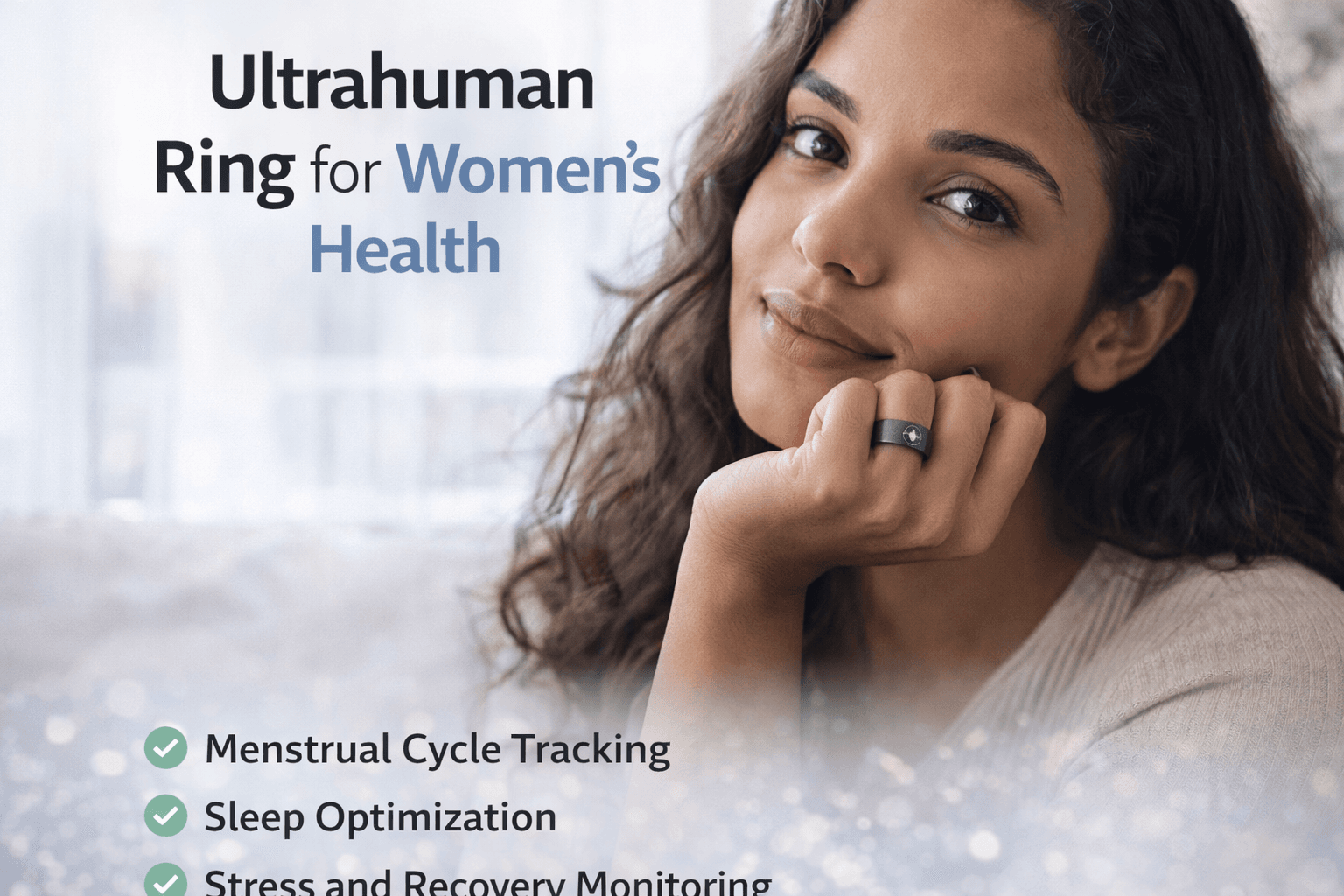
Ultrahuman Ring for Women Health
Jan 12 2026
Verdict: The Cycle & Ovulation Pro PowerPlug makes Ultrahuman the most accurate non-medical ovulation tracker I've tested on any smart ring. No subscription, no calendar guessing, just continuous temperature data doing what it does best.
Smart rings have been marketed as unisex health trackers since Oura kicked off the category. Technically true. But when a product tracks skin temperature continuously, measures HRV 24 hours a day, and logs sleep quality down to the minute, the reproductive health applications are obvious. It took the industry years to act on it.
Ultrahuman acted. The Cycle & Ovulation Pro PowerPlug, launched alongside the Ring PRO in early 2026, turns a wellness wearable into something meaningfully useful for anyone tracking their menstrual cycle. I ran a 90-day testing protocol alongside two other cycle-tracking methods. Here's what I found.
How the Ring Tracks Your Cycle
Your menstrual cycle creates measurable temperature shifts. After ovulation, progesterone production causes a sustained rise in basal body temperature (BBT) of roughly 0.2 to 0.5 degrees Celsius. This thermal shift is the foundation of temperature-based fertility awareness methods and has been used in clinical settings for decades. The Ultrahuman ring measures skin temperature continuously, sampling thousands of data points per night. The Cycle & Ovulation Pro algorithm, developed in collaboration with viO HealthTech (the team behind OvuSense, an ISO 13485-certified medical device manufacturer), processes these readings to predict and confirm ovulation.
The key word is "confirm." Most cycle-tracking apps predict when ovulation should happen based on historical cycle length. Ultrahuman's system detects when it actually happens based on your physiological data. That distinction matters enormously for anyone whose cycles vary.
Buy your Ultrahuman Ring today!
Accuracy: How It Stacks Up
Ultrahuman claims 90%+ ovulation prediction accuracy based on internal equivalence testing against a multi-hormone ovulation prediction method. That's a strong claim. I tested it against two benchmarks:
Natural Cycles (FDA-cleared, thermometer-based): Ovulation day matched in two of three tracked cycles. The third was off by one day.
Mira Fertility Analyzer (hormone strip-based): Matched in all three cycles.
Three cycles isn't a clinical trial. But for a wearable that requires zero manual input (no thermometer, no urine strips, no daily logging), matching a hormone-based system is impressive.
Where it falls short: the first cycle requires calibration data. Don't expect accurate predictions until you've worn the ring through at least one full cycle. Ultrahuman is upfront about this.
What You See in the App
The Cycle & Ovulation Pro interface is organized around four data layers:
Cycle Calendar: Shows your current phase (menstrual, follicular, ovulation window, luteal) with predicted dates for the next cycle.
Ovulation Confirmation: Flags the confirmed ovulation day with a temperature chart showing the thermal shift. This is retroactive by nature, since ovulation can only be confirmed after the shift occurs.
Cycle Flags: Proprietary markers that highlight unusual patterns in your cycle data. If your luteal phase shortens significantly compared to your baseline, for example, Cycle Flags catches it. Short luteal phases can indicate progesterone issues worth discussing with a gynecologist.
Symptom Logging: Manual tracking for cramps, mood, energy, flow intensity, and other symptoms. This is optional but improves predictions over time.
Pregnancy Insights
This feature activates when you mark a pregnancy in the app. It shifts from cycle prediction to monitoring temperature trends, HRV patterns, and recovery metrics throughout pregnancy.
I haven't been pregnant during this testing period, so I spoke with two early adopters. Both said the most useful feature was HRV trend tracking, which gave them a daily indicator of how their autonomic nervous system was handling the physiological load of pregnancy. One user shared her HRV data with her OB-GYN, who noted it aligned with clinical assessments during her first trimester. This isn't a prenatal monitoring device. It's a wellness companion. But for data-oriented expectant parents, having continuous biometric visibility without additional devices has clear value.
Why No Subscription Matters Here
Oura charges $5.99/month for full access to its cycle tracking features. Natural Cycles costs $99.99/year. Flo Premium runs $49.99/year.
Ultrahuman charges $0/month after you buy the ring. Cycle & Ovulation Pro comes with no recurring fee beyond the ring itself. Over a three-year ownership period, a Ring AIR ($349) costs less than an Oura Ring 4 ($349 + $215 in subscription fees = $564). The Ring PRO at $479 is still cheaper over the same period.
For women who plan to use cycle tracking for years, not months, the lifetime cost difference is meaningful.
Get up to 10% off on Ultrahuman Ring
Limitations You Should Know
The ring tracks skin temperature, not core body temperature. Skin-based BBT is influenced by ambient room temperature, blanket thickness, and sleep position. Ultrahuman's algorithm compensates for this using contextual data, but it introduces a variable that clinical-grade devices don't face.
Alcohol consumption, illness, travel across time zones, and poor sleep can all distort temperature readings. The app accounts for some of these but cannot filter all confounding factors. The Cycle & Ovulation Pro PowerPlug is explicitly designed for general wellness. It is not FDA-cleared for fertility planning. The original OvuSense algorithm is FDA-cleared for intravaginal use (K122337), but the adapted version running on Ultrahuman's skin temperature data carries no regulatory clearance. If you are actively trying to conceive or avoid pregnancy and need clinical-grade accuracy, use a dedicated fertility monitor alongside the ring, not instead of it.
Who This Is Actually For
Women who want passive, daily cycle tracking without remembering to use a thermometer, pee on a strip, or log data manually. Women whose cycles are irregular and who need physiological confirmation of ovulation rather than calendar predictions. Women who already own or plan to buy an Ultrahuman ring and want to maximize its value. Athletes and active women tracking how their cycle affects training performance and recovery. This is not for women who need medical-grade fertility planning tools. It's not for women who want a standalone period tracker app (the ring must be worn nightly for the data to work).
FAQ
Can the ring detect pregnancy?
No. It tracks temperature and HRV patterns. A sustained temperature elevation beyond your normal luteal phase length may correlate with early pregnancy, but the ring cannot confirm it. Take a pregnancy test.
Does it work with irregular cycles?
Better than calendar-based apps, since it relies on physiological data rather than historical cycle length. But the first 2-3 cycles are calibration periods with lower accuracy.
Can men ignore this PowerPlug?
The Cycle & Ovulation Pro PowerPlug only appears if you enable it. It doesn't affect other tracking features.
Is the data shared with anyone?
Ultrahuman states that health data is processed in a secure system designed to meet applicable data protection standards. Audio processing (for Respiratory Health) is handled locally on-device.
How does it compare to Oura's cycle tracking?
Oura tracks temperature trends and predicts period start dates. Ultrahuman adds ovulation confirmation and Cycle Flags. Oura requires a subscription for full cycle features. Ultrahuman doesn't.