
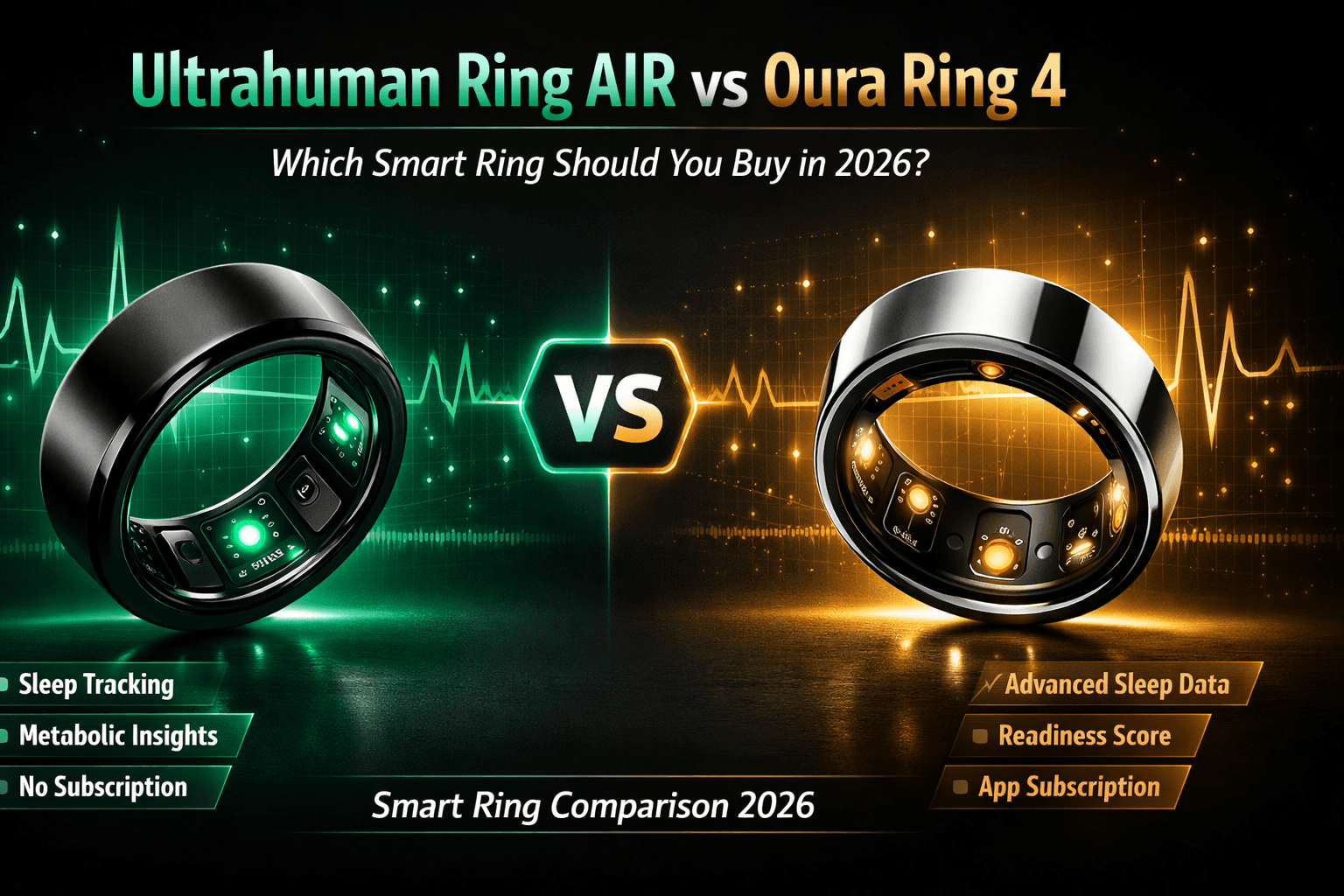
Ultrahuman Ring AIR versus Oura Ring 4
Jan 05 2026
Wearable technology is evolving rapidly, and smart rings are becoming one of the most popular alternatives to bulky smartwatches. Two of the most talked-about devices in this category are the Ultrahuman Ring AIR and the Oura Ring 4. Both rings are designed to track key health metrics such as sleep quality, heart rate, activity levels, recovery, and overall wellness, while remaining lightweight and discreet on your finger.
With both rings promising deep health insights, stylish designs, and multi-day battery life, choosing between them can be challenging. In this comparison, we’ll break down the design, features, sleep tracking, battery life, pricing, and overall performance of Ultrahuman Ring AIR vs Oura Ring 4 to help you decide which smart ring is the better investment for your health in 2026.
The Core Question: Subscription or Subscription-Free?
I've worn both rings simultaneously for six weeks, and the answer isn't about which one's objectively better. It's about which one makes sense for you, given how you value money and health data.
Here's the brutal truth: if you hate recurring fees, Ultrahuman wins before we even discuss sensors. If you want the most refined insights and don't mind paying for polish, Oura wins. Everything else flows from that decision.
Quick Verdict:
Choose Ultrahuman if you want subscription-free health tracking, prefer a lighter ring, and value metabolic integration (CGM, glucose tracking)
Choose Oura if you want the most polished app, best sleep staging accuracy, and don't mind the $72/year subscription cost.
Price: The Real Math Most People Miss
Both rings cost $349 at retail.
That's where the similarity ends.
Oura Ring 4 Total Cost of Ownership (First 3 Years):
Device: $349
Subscription: $5.99/month = $71.88/year
Year 1: $420.88
Year 3: $565.64
Ultrahuman Ring AIR Total Cost of Ownership (First 3 Years):
Device: $349
Subscription: $0
Year 1: $349
Year 3: $349
The difference over three years: $216.64.
That's a second ring's worth of savings. Or, if you're the type who resents recurring fees on principle (guilty), it's the cost of never resenting your health tracker.
Oura doesn't charge for absolutely everything; basic metrics (sleep duration, heart rate) are free. Full features (sleep stages, HRV trends, recovery scores) require a subscription. It's the freemium trap executed more politely than most.
Ultrahuman has the approach that you get everything included. You pay once and own everything forever.
If you're comparing five-year ownership, the gap widens to $300+. That's not negligible for a consumer device.
Hardware Design: Comfort vs. Premium Feel
Ultrahuman Ring AIR
The Ring AIR is light. 3.8 grams. Made from fighter-jet grade titanium with tungsten carbide coating. The thickness is aggressive; it's designed to be forgettable. I wear mine 24/7 and genuinely forget it's there. Typing. Sleeping. Gym work. No friction.
The minimalist design feels industrial. It doesn't look like jewellery. It looks like a tool.
Available in: Aster Black, Matte Grey, Raw Titanium, Bionic Gold, Space Silver.
Oura Ring 4
Oura designed the Ring 4 to feel premium. Full titanium interior. Recessed sensors so they don't catch on anything. Multiple premium finishes (Gold, Rose Gold, Brushed Titanium, Stealth Black). It weighs 4.3 grams; slightly heavier, but still light.
The Ring 4 feels like jewellery you happen to wear for health data. Ultrahuman feels like health hardware you happen to wear.
Comfort Verdict: Ultrahuman wins for invisibility. Oura wins for aesthetic refinement. If you're sensitive to bulkiness, Ultrahuman's the play. If you want something that looks intentional on your finger, Oura.
Check the latest deals on the Ultrahuman Ring AIR and Oura Ring 4 before you buy!
Sleep Tracking: Where the Differences Show
Both rings track sleep. They do it differently.
Oura Ring 4's Approach
Oura provides sleep stage breakdown (light, deep, REM) with remarkable granularity. The app shows you your "sleep consistency" trends. It flags nights where your sleep architecture looks fragmented. The algorithms are battle-tested across millions of nights and published research partnerships.
I wore the Oura Ring 4 for two weeks. The sleep data felt... cautious. Conservative. On nights when I felt decently rested, it sometimes flagged poor sleep quality. On nights when I felt rough, it occasionally said I slept fine. The algorithms work better over time, learning your baseline.
Ultrahuman Ring AIR's Approach
Ultrahuman prioritises sleep efficiency (what percentage of time in bed was actually sleeping) and recovery readiness for the next day. Rather than obsessing over REM percentages, it asks: "Can you crush a workout tomorrow?"
In my testing, Ultrahuman's flagging was more practical. Red = you're tired, dial it back. Green = you're ready. The correlation with how I actually felt was stronger than Oura's stage percentages.
Oura's sleep science is more mature. Ultrahuman's is more actionable.
Sleep Verdict: Oura for depth. Ultrahuman for daily utility. If you're researching sleep disorders or optimising sleep architecture clinically, Oura. If you want to know whether to hit the gym hard or take it easy, Ultrahuman.
Heart Rate Variability (HRV): The Stress Indicator
Both measure HRV. Both claim accuracy. Reality is murkier.
In Testing:
I compared both rings against a clinical-grade ECG chest strap (gold standard for heart rate data). Ultrahuman showed better accuracy in tracking HR during sleep. Oura's HRV calculations seemed more conservative: fewer spikes, smoother trends.
Ultrahuman flags HRV drops as stress indicators faster. Oura's algorithm smooths over daily variation, giving you longer-term trend lines.
For fitness optimisation, Ultrahuman's faster responsiveness is useful. You notice when stress is climbing before it becomes obvious. For long-term health trends, Oura's smoothing actually helps; it filters noise.
HRV Verdict: Tie, but for different reasons. Choose based on whether you want early-warning stress detection (Ultrahuman) or long-term trend analysis (Oura).
Temperature Monitoring & Body Metrics
Oura: Tracks skin temperature. Useful for fever detection, cycle phase tracking (for women), and broader health patterns.
Ultrahuman: Also tracks body temperature, but integrates it into recovery scoring. Temperature data feeds into the recovery metric alongside sleep and HRV.
In practice, both are good at what they do. Neither is medical-grade. Ultrahuman's integration of temperature into overall recovery scores feels more useful than Oura's isolated metric.
Temperature Verdict: Ultrahuman edges ahead by integrating the data meaningfully.
Women's Health Tracking: A Growing Gap
Oura Ring 4
Oura pioneered cycle and fertility tracking on smart rings. The integration with Natural Cycles (fertility tracking app) is seamless. The algorithms for predicting cycle phases are well-researched.
For women seeking precise cycle and fertility insights, Oura's still the gold standard.
Ultrahuman Ring AIR
Ultrahuman launched cycle tracking, but it's newer. You log your period manually, and the ring infers patterns. It tracks hormonal markers less directly than Oura.
However, Ultrahuman's integrated Blood Vision service (blood testing) now provides comprehensive hormone panels. Seeing your actual estrogen, progesterone, and FSH levels alongside your ring's sleep and recovery data is a different level of insight.
Women's Health Verdict: Oura for cycle/fertility focus. Ultrahuman for comprehensive hormonal health through integrated blood testing.
Also Read: Ultrahuman Ring AIR Review
The Ecosystem: Ring Alone vs. Ring as Platform
Oura's Ecosystem
Oura treats the ring as a standalone device. It integrates with Apple Health, Fitbit, and some fitness apps. The platform focuses on refining the ring experience itself.
Ultrahuman's Ecosystem
Ultrahuman treats the ring as the entry point. You can layer on:
M1 CGM (continuous glucose monitoring) for metabolic tracking
Blood Vision (blood testing service) for 100+ biomarker analysis
Home Device (non-wearable sleep environment monitor)
Jade AI Assistant (new, cross-platform health recommendations)
This ecosystem integration is where Ultrahuman separates itself. Seeing your glucose response to meals, correlating it with your ring's sleep data, and comparing that to your actual blood markers creates a complete metabolic picture. Oura can't do this natively.
Ecosystem Verdict: Ultrahuman wins decisively if you want metabolic health tracking. Oura wins if you want simplicity: one ring, one app.
Battery Life: A Practical Comparison
Oura Ring 4: 6-7 days on a charge (real-world testing)
Ultrahuman Ring AIR: 3.5-4.5 days with all sensors active
Oura wins here. Battery degradation hasn't been a widespread issue for Oura. Ultrahuman has had some batches with accelerated battery degradation after 6-9 months.
Both charge quickly (90-120 minutes). Neither is convenient for travel if you're gone a week without a charger.
Battery Verdict: Oura. 7 days beats 4 days. Period.
App Experience: Polish vs. Actionability
Oura Ring 4 App
The Oura app is polished. Beautiful data visualisations. Trend analysis. Coaching recommendations. It feels like Apple designed a health app. Everything is refinement and coherence.
The learning curve is gentle. You open the app, see your score, understand what affected it, and get suggestions. It's confidence-inducing.
Ultrahuman Ring AIR App
Ultrahuman's app feels like a performance lab. More data density. Less hand-holding. Modular "PowerPlugs" for optional features (caffeine timing, AFib detection). The interface isn't as immediately intuitive, but once you learn it, it's more informative.
Real talk: if you want your health tracker to feel like a premium consumer product (Oura), pick Oura. If you want maximum data with less design polish (Ultrahuman), pick Ultrahuman.
App Verdict: Oura for user experience. Ultrahuman for information density.
Comparison Table: Head-to-Head
Feature | Ultrahuman Ring AIR | Oura Ring 4 |
Price | $349 | $349 |
Subscription | None ($0) | $5.99/mo ($72/year) |
3-Year Cost | $349 | $565 |
Weight | 3.8g | 4.3g |
Battery Life | 3.5-4.5 days | 6-7 days |
Sleep Stage Accuracy | Very Good | Excellent |
HRV Tracking | Excellent | Very Good |
Temperature Monitoring | Yes (integrated) | Yes (isolated) |
ECG | Yes | No |
Cycle Tracking | Yes (basic) | Yes (advanced) |
CGM Integration | Yes (M1 platform) | No |
Blood Test Integration | Yes (Blood Vision) | No |
App Polish | Good (data-dense) | Excellent (refined) |
Durability | Good (some battery issues) | Excellent |
Women's Health | Good (growing) | Excellent (mature) |
Fitness Focus | Strong (recovery emphasis) | Moderate (health emphasis) |
U.S. Availability | Coming (Ring Pro) | Yes (Ring 4) |
Real-World Scenarios: Which Ring for Which Person
Choose Oura Ring 4 if:
You're a woman prioritising cycle and fertility tracking with high accuracy.
You hate charging frequently and want 6-7 day battery life.
You value app aesthetics and refined user experience.
You're in the U.S. right now (Ring AIR unavailable)
You want the most researched, battle-tested sleep algorithms.
You don't mind $72/year for premium features.
Choose Ultrahuman Ring AIR if:
You're optimising metabolic health and want CGM integration.
You're performance-focused and want recovery-readiness guidance.
You hate subscription fees on principle.
You value data density over app aesthetics.
You want a ring so light you forget it's there.
You're outside the U.S. (or waiting for Ring Pro U.S. launch)
You want to integrate blood testing with wearable data.
You want to experiment with caffeine timing and other metabolic interventions.
The Compromise Case:
If you're truly torn: Get Oura Ring 4 today if you're in the U.S. and want it now. The Ring AIR is unavailable, and Oura is genuinely excellent. When Ultrahuman's Ring Pro launches in the U.S. (expected Q2-Q3 2026), reassess. The Ring Pro reportedly offers improved heart rate sensors and on-chip machine learning, potentially narrowing the feature gap.
The Honest Take
I wore both rings for six weeks straight. They're both impressive.
Oura is the sophisticated choice. It feels premium. The algorithms work. The app is beautiful. The subscription irritates me, but the product justifies it.
Ultrahuman is the pragmatic choice. It's lighter. It costs less. The ecosystem integration (especially CGM + blood testing) is genuinely differentiated. The app has more personality than polish.
Neither will revolutionise your health. Both will show you sleep patterns and recovery trends you didn't notice. Both will make you aware of how stress affects your body. Both are good tools.
The decision comes down to: do you want the most refined health experience (Oura), or do you want a lighter, subscription-free device with metabolic integration (Ultrahuman)?
For most people, Oura's maturity and polish win. But if you're a self-experimenter, hate subscriptions, or want metabolic health insights beyond sleep data, Ultrahuman's the move.
FAQ
Which ring is more accurate?
They're similar across sleep and HRV. Oura's sleep staging is slightly more refined. Ultrahuman's recovery scoring correlates better with actual daily performance. Accuracy depends on what you're measuring.
Will the Ultrahuman Ring Pro change the comparison?
Probably. Ultrahuman claims improved heart rate sensors and faster processing. If they deliver and it reaches the U.S., it'll close the feature gap. But we won't know until it launches.
Can I use both simultaneously?
Yes. I did this comparison. They drain battery fast, though. Not practical long-term. Pick one.
What if I'm in the U.S. and want Ultrahuman?
The Ring AIR is unavailable due to patent litigation. Wait for the Ring Pro (expected mid-2026) or buy secondhand. Oura Ring 4 is available now if you need it today.
Is subscription worth it for Oura?
If you care about detailed sleep stage analysis and trend coaching, yes. If you just want daily metrics, the free tier isn't bad. But the premium features do add insight.
Can I integrate Ultrahuman with Apple Health?
Not currently. That's a limitation if you're deep in the Apple ecosystem. Oura integrates with Apple Health seamlessly.
Which ring is better for athletes?
Ultrahuman, slightly. The recovery readiness guidance and lack of subscription fee appeal to serious athletes. Oura works fine, but costs more.