
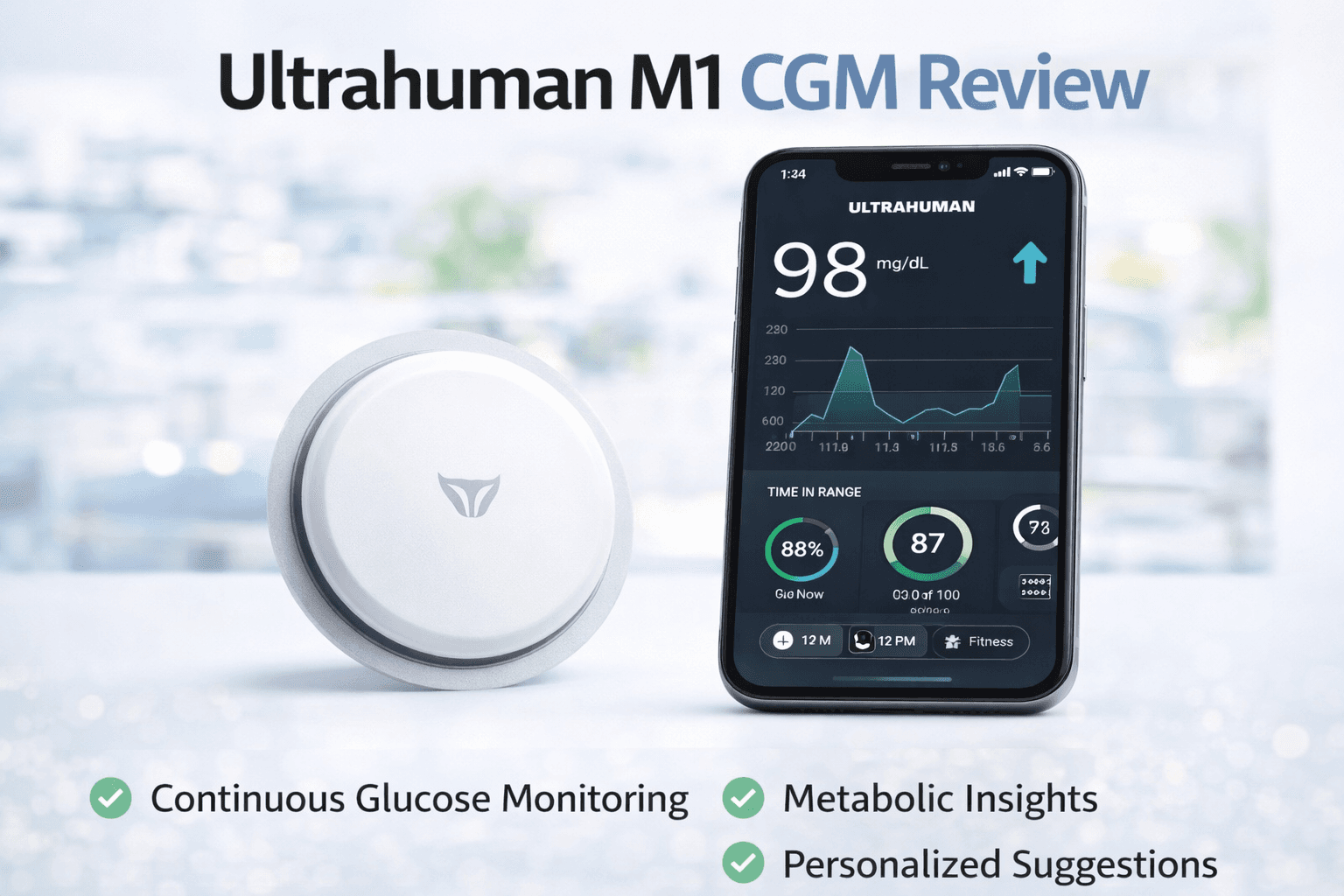
Ultrahuman M1 CGM Review
Jan 04 2026
Verdict: Two weeks with a CGM will teach you more about your body's response to food than five years of reading nutrition articles. The M1 platform makes that data genuinely actionable. But the ongoing cost is steep for a wellness tool.
I put an Abbott FreeStyle Libre sensor on the back of my left arm on a Sunday morning. Fourteen days later, I'd changed my breakfast permanently, learned that white rice spikes my glucose harder than a candy bar, and discovered that a 10-minute post-meal walk cuts my glucose peak by roughly 30%.
None of this was news in a clinical sense. Nutritional science has documented all of it. But there's a canyon between knowing something intellectually and watching your glucose climb to 168 mg/dL on a real-time graph after a bowl of oatmeal you thought was healthy.
The Ultrahuman M1 is the platform that bridges that canyon. Whether it's worth $299 per month depends on how seriously you want to understand your metabolism.
How It Works
The Ultrahuman M1 isn't a sensor. It's a software platform that connects to an FDA-approved Abbott FreeStyle Libre continuous glucose monitor. The sensor is a small disc (about the size of a two-rupee coin) that sits on your upper arm. A tiny 5mm filament rests under your skin and measures interstitial glucose levels continuously for 14 days. You don't feel it after the first hour. It survives showers, workouts, and swimming up to two meters depth for 30 minutes. I wore mine through hot yoga, a CrossFit session, and daily showers without any issues.
The sensor sends data to the Ultrahuman app via Bluetooth or NFC scan. The app turns raw glucose numbers into actionable insights: a Metabolic Score (0-100), food scores for individual meals, glucose zone analysis, and correlations between glucose behavior and your sleep, exercise, and stress levels. If you also use an Ultrahuman Ring, the app cross-references glucose data with HRV, sleep quality, and recovery metrics. That integration is where the M1 stops being a glucose monitor and starts being a metabolic intelligence platform.
What the M1 Actually Taught Me
Week 1: The wake-up call
Day 1, breakfast. Steel-cut oatmeal with banana and honey. Glucose before eating: 92 mg/dL. Glucose 45 minutes later: 162 mg/dL. That's a 70-point spike from what I considered a "healthy" breakfast.
Day 2, I swapped to eggs with avocado and sourdough toast. Same time, same hunger level. Glucose peaked at 118 mg/dL. A 26-point spike. Same meal satisfaction, completely different metabolic response.
Over seven days, I scored every meal. The patterns were consistent. My body handles protein and fat well. Simple carbs, even "healthy" ones like oatmeal and bananas, trigger aggressive spikes. White rice was the worst offender: 174 mg/dL after a dinner portion.
Buy your Ultrahuman M1 CGM Today
Week 2: The optimization
Armed with Week 1 data, I restructured my meals. Protein first, then vegetables, carbs last. Added a 10-minute walk after lunch and dinner. Started eating dinner 30 minutes earlier.
Results: my average glucose dropped from 108 mg/dL to 94 mg/dL. Time in target range (70-110 mg/dL) improved from 71% to 89%. My Metabolic Score averaged 82, up from 64.
More importantly, my Ring AIR showed that my deep sleep increased by an average of 14 minutes per night during Week 2. The Ultrahuman app correlated this with lower nocturnal glucose variability. I'd read that stable glucose improves sleep. Now I had my own data proving it.
The App Experience
The M1 interface is the best part of the platform. Glucose data alone is noise. The app converts it into signals.
Food Scoring: Log a meal (snap a photo or type it in) and the app scores your glucose response from 1-10 based on spike magnitude, duration, and time over target. After a week, you know which foods your body handles well and which ones it doesn't.
Correlations Screen: Overlay glucose data with other biomarkers. I spent an unreasonable amount of time comparing glucose variability against my HRV readings. The correlation was visible: high glucose variability days consistently produced lower HRV readings the following night.
Coaching: Ultrahuman includes free in-app coaching with the M1 subscription. Certified coaches respond to questions and help interpret data. Response times were under 4 hours during business hours. The advice was practical and specific to my data, not generic nutrition templates.
The Cost Problem
The M1 isn't cheap:
Plan | Price | Sensors Included |
1 Month | $299 | 2 sensors (14 days each) |
3 Months | $699 | 6 sensors |
1 Year | $2,399 | 26 sensors |
Tap in to get 20% off for New Users
The 20% introductory discount brings the monthly cost to $239, but even discounted, this is a significant wellness expense. Compare it to competitors: Dexcom Stelo costs $89/month. Abbott Lingo sells individual sensors for $49 at Walgreens.
Ultrahuman's premium sits in the software layer. The coaching, the metabolic scoring, the Ring integration, and the food analytics justify some markup. Whether they justify 3x the price of a basic sensor depends on how much you value the interpretation versus the raw data.
My recommendation: use the M1 for one month. That's enough to learn your body's glucose patterns, identify problem foods, and establish a new dietary baseline. You don't need continuous glucose monitoring forever. You need it long enough to build awareness. For most non-diabetic users, 28 days is sufficient.
Who This Is For (and Who Should Skip It)
Use the M1 if: You're serious about metabolic health optimization. You want data-driven dietary changes. You're an athlete looking to optimize fueling strategies. You already use an Ultrahuman Ring and want ecosystem integration.
Skip it if: You have a limited wellness budget (a Ring alone gives you 80% of the health value). You already eat well and sleep well. You're looking for a diagnostic tool (the M1 is a wellness platform, not a medical device). You have diabetes and need a medically supervised CGM protocol.
US Availability and Prescription Requirement
The M1 is available in the US, UK, Netherlands, India, and other markets. In the United States, a medical consultation is required before purchase. Ultrahuman includes a telehealth appointment as part of the ordering process. The consultation takes about 10 minutes and covers eligibility.
In India, the M1 is available over the counter through Ultrahuman's website and Amazon.in.
FAQ
Does the sensor hurt?
No more than an ant bite. A spring-loaded applicator inserts the filament. I felt a brief pinch that faded within seconds.
Can I wear it during exercise?
Yes. It's designed for continuous wear including workouts and swimming.
Do I need an Ultrahuman Ring to use the M1?
No. The M1 works as a standalone platform. But the Ring integration adds significant value by correlating glucose with sleep and recovery data.
How accurate is the glucose reading?
The Abbott FreeStyle Libre sensor is FDA-approved with documented clinical accuracy. Interstitial glucose readings can lag blood glucose by 5-15 minutes.
Can I use the M1 data with my doctor?
Yes. The app exports glucose data in standard formats. Several users have reported sharing M1 insights with endocrinologists and nutritionists.