
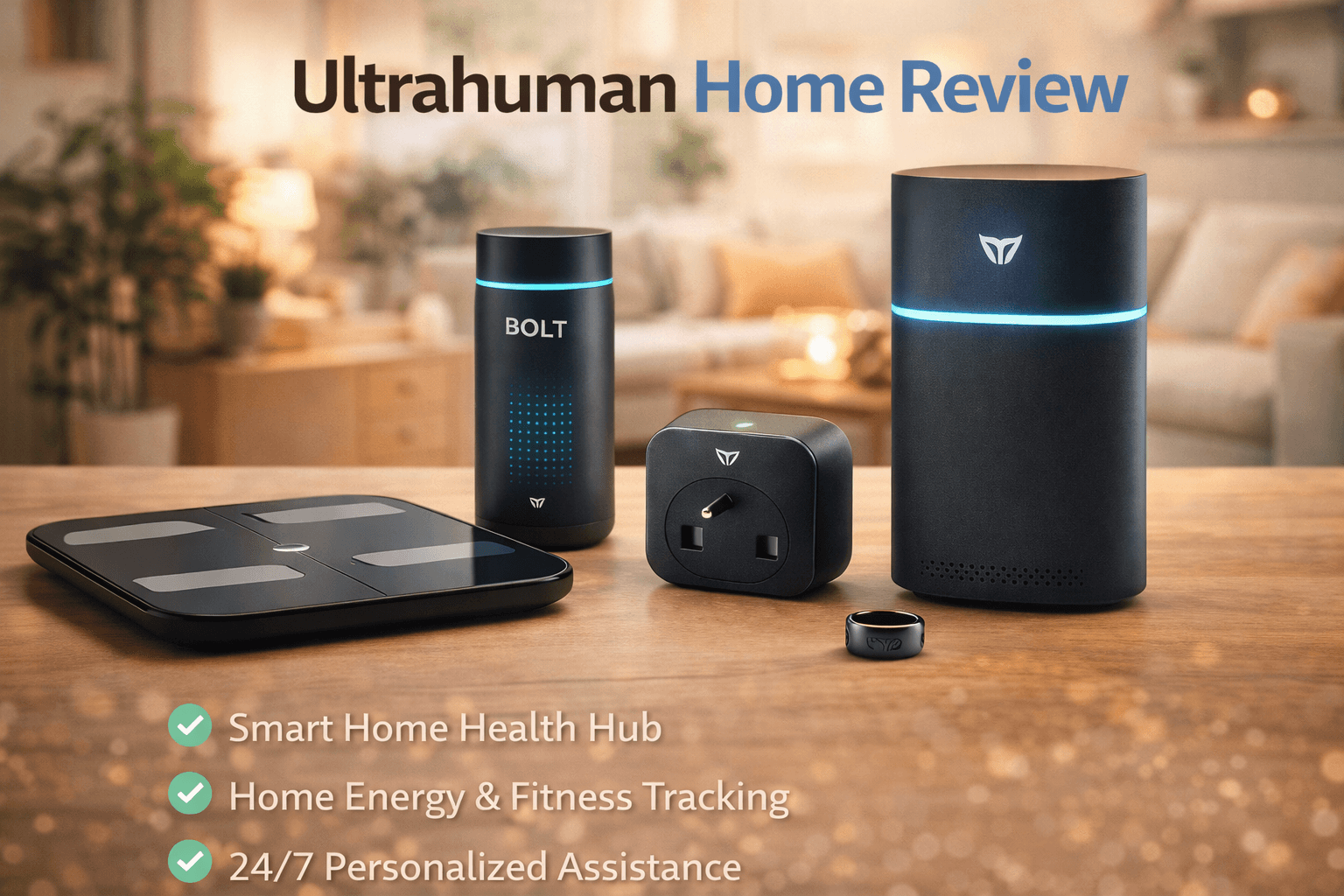
Ultrahuman Home Review
Feb 17 2026
Verdict: The $549 price tag is hard to swallow for a screenless box. But after three months, Ultrahuman Home changed one habit (opening a window before bed) that improved my deep sleep by 18 minutes per night. That ROI is hard to argue with.
Most people who buy a sleep tracker focus on what their body is doing at night. Heart rate, HRV, sleep stages, skin temperature. Valid data, all of it. But it ignores a variable that research has hammered for decades: the room you're sleeping in. CO₂ levels above 1,000 ppm impair cognitive function. Particulate matter below 2.5 microns (PM2.5) penetrates deep lung tissue. Room temperature above 20 degrees Celsius suppresses melatonin production. Artificial blue light after sunset disrupts circadian signaling.
You know all of this. You've read the studies. You've probably even bought blackout curtains. But do you know what your bedroom CO2 level hits at 3am with the door closed? I didn't, until I plugged in an Ultrahuman Home. The answer, for my bedroom, was 1,847 ppm. That's nearly double the level where cognitive impairment begins. I was essentially sleeping in a poorly ventilated box every night and wondering why my recovery scores were mediocre.
What Ultrahuman Home Actually Measures
The Home is a compact aluminum box (roughly Mac Mini-sized) that sits on your nightstand and monitors eight environmental categories continuously:
Air Quality: CO2, PM1.0, PM2.5, PM10, VOC (volatile organic compounds), HCHO (formaldehyde), CO (carbon monoxide)
Environmental Comfort: Temperature, humidity, noise levels
Light: Blue light intensity, UV exposure, circadian alignment scoring
Respiratory Analysis: Snoring detection, coughing frequency, irregular breathing patterns (via built-in microphone with AI spatial audio)
Every metric gets a real-time status rating (Optimal, Safe, Moderate, Elevated, Caution, Critical) and feeds into an overall Room Score from 0-100. The scoring matches Ultrahuman's system across all their products, so if you're familiar with your sleep score or recovery score, the Room Score feels intuitive immediately.
Order Now to get discounts on Ultrahuman home products!
Three Months of Data: What Changed
Month 1: Discovering the CO2 problem
My first week's data was revealing. Bedroom CO2 consistently hit 1,400-1,800 ppm between 1am and 5am. Temperature climbed to 22.5 degrees by 4am. PM2.5 stayed low (I live in a suburban area away from main roads), but humidity dropped to 28% overnight, well below the 30-60% healthy range.
The fix was embarrassingly simple: crack a window an inch before bed. Within three nights, my peak CO2 dropped to 680 ppm. Temperature stabilized at 18-19 degrees. Humidity stayed above 35%.
My Ring PRO's deep sleep average that first month climbed from 48 minutes to 66 minutes per night. I cannot attribute all 18 minutes to CO2 reduction alone, multiple variables changed simultaneously. But the correlation in my data was stark.
Month 2: The snoring discovery
I enabled the Respiratory Health feature, which uses the Home's microphone for audio-based sleep analysis. The AI model identifies up to 500 sounds and categorizes them. I learned two things: I snore mildly between 2am and 3am (nobody had told me), and my neighbor's dog barks at 5:15am three mornings a week.
The snoring correlated with nights where I slept on my back. My side-sleeping nights showed no snoring. Simple behavioral data that I would never have discovered without ambient audio monitoring.
Month 3: The correlation payoff
By month three, the Home had enough data to show real patterns. Jade AI (which integrates Home data when available) surfaced an insight I hadn't caught: my highest recovery scores consistently followed nights where room temperature stayed below 19 degrees and CO2 stayed below 800 ppm. Nights that exceeded either threshold produced recovery scores 8-12 points lower.
This is where the Ultrahuman ecosystem starts to justify its cost. No single device produced that insight. It required ring biometrics plus environmental monitoring plus AI correlation.
Tap in to buy Ultrahuman home now!
Privacy: The Microphone Question
A device with a microphone in your bedroom is going to raise privacy concerns. Ultrahuman addresses this in three ways.
First, a physical mic switch on the device. Flip it, and the microphone is hardware-disabled. No software override is possible.
Second, all audio processing happens locally on the device. Ultrahuman states that audio recordings are not streamed or stored on their servers.
Third, the company claims compliance with HIPAA and GDPR data protection standards.
I kept the microphone enabled because the respiratory data was useful to me. If you're uncomfortable with bedroom audio recording, the Home still provides full air quality, temperature, humidity, and light monitoring with the mic physically disabled. You lose snoring and noise detection, but keep everything else.
How It Connects to the Ecosystem
The Home communicates with your Ring AIR or Ring PRO through a feature Ultrahuman calls UltraSync. When both devices are active, environmental events (noise spikes, temperature changes, CO2 elevation) are mapped against your sleep stages and awakenings.
If your ring detected a waking event at 3:17am and the Home logged a noise event at 3:17am, Jade AI can tell you that noise disrupted your sleep at that specific time. Without both devices, you'd know you woke up but not why. Smart home integration through Matter and Thread protocols is listed as "coming soon." When it arrives, the Home should be able to trigger actions like adjusting your smart thermostat or activating an air purifier when environmental thresholds are breached during sleep. This isn't live yet.
The Price Reality
At $549, the Ultrahuman Home costs more than most standalone air quality monitors. An Awair Element ($149) or IQAir AirVisual ($269) will track air quality at a lower price point. But neither integrates with a wearable ecosystem, neither offers respiratory audio analysis, and neither correlates environmental data with your biometric sleep data. You're paying for the ecosystem integration. If you don't own an Ultrahuman Ring, the Home is an overpriced air quality monitor. If you do own a ring, the Home unlocks a data layer that makes both products significantly more valuable.
Click here to buy Ultrahuman home today!
FAQ
Does Ultrahuman Home require a subscription?
No. All features are included with the hardware purchase.
Does it need WiFi?
Yes. It connects via WiFi for app syncing and firmware updates.
Is it battery-powered?
No. It runs on USB-C power and consumes under 2 watts. It needs to be plugged in continuously.
Can multiple people use it?
One Home device serves one room. Your household member can receive notifications if they also use the Ultrahuman app, but each person needs their own ring for biometric correlation.
How big is it?
Roughly 95mm x 95mm x 45mm. It fits on a nightstand without taking up much space.
Does it work without a Ring?
Yes, as a standalone environment monitor. But the full value requires ring integration for biometric-environmental correlation.