
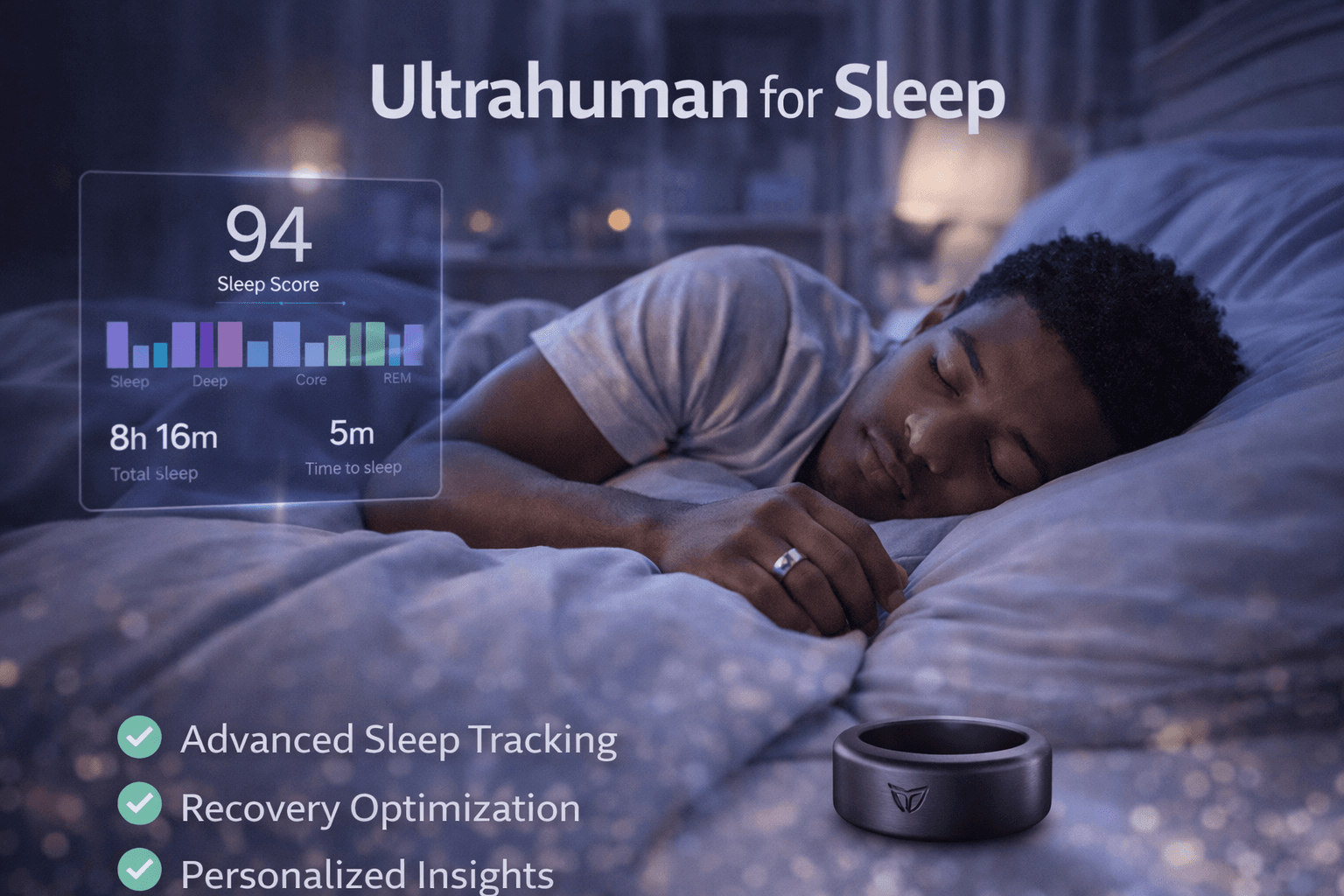
Ultrahuman for Sleep
Feb 25 2026
Verdict: The Ultrahuman ecosystem is the most comprehensive sleep optimisation stack available to consumers in 2026. Ring for biometrics, Home for environment, M1 for metabolic impact, and Jade for correlations. No other company connects all four layers.
I've tested sleep trackers for eight years. Fitbits, Garmins, Oura Rings, Whoop bands, Apple Watch, Eight Sleep, and a polysomnography study at a university lab. After all of that, the best sleep improvement I ever made had nothing to do with a device. I cracked a window. That sounds ridiculous. It's not. The Ultrahuman ecosystem taught me that my sleep problem was never about my body. It was about my room. But I needed data from three different devices, cross-referenced by an AI system, to see it.
Here's the full playbook: how to use Ultrahuman's products to actually improve your sleep, not just measure it.
Layer 1: The Ring (What Your Body Is Doing)
Your Ultrahuman ring (AIR or PRO) tracks five sleep metrics every night:
Total Sleep Time. How long you actually slept, excluding awakenings.
Sleep Stages. Light sleep, deep sleep, and REM, measured via heart rate patterns, HRV, and movement.
Sleep Latency. How long did it took you to fall asleep after getting into bed.
Restfulness. A composite score reflecting awakenings, tossing, and movement intensity during sleep.
Skin Temperature. Nightly temperature trends that indicate recovery status, illness onset, and hormonal fluctuation.
The morning summary also includes a recovery score (how ready your body is for strain) and an HRV baseline comparison (are you above, at, or below your personal average).
Most people stop here. They check their sleep score, note whether it's good or bad, and move on. That's tracking, not optimization. The score tells you what happened. It doesn't tell you why.
Buy the Ultrahuman Ring Today!
Layer 2: Ultrahuman Home (What Your Room Is Doing)
This is the layer most sleep trackers ignore entirely. Your ring can tell you that your deep sleep was 38 minutes last night. It cannot tell you that your CO2 hit 1,600 ppm at 3am because your bedroom door was closed.
Ultrahuman Home sits on your nightstand and monitors air quality (CO2, PM2.5, VOCs, formaldehyde), temperature, humidity, noise, and light. The Respiratory Health feature analyzes snoring patterns, coughing, and breathing irregularities using AI spatial audio processing.
When paired with your ring via UltraSync, environmental events are mapped against your sleep stages. Here's what this looked like in my data:
My ring showed consistent light sleep between 2am and 4am. Standard interpretation: I sleep lightly in the second half of the night, which is normal to some degree.
The Home showed that CO2 peaked above 1,400 ppm during that same 2-4am window. Once I started ventilating the room before bed, the CO2 peak dropped to 700 ppm and my light sleep block shortened by roughly 25 minutes. Deep sleep replaced it.
Without the environmental data, I would have accepted light sleep as a fixed personal pattern. With it, I found a variable I could change.
Layer 3: M1 CGM (What Your Metabolism Is Doing)
This layer is optional but powerful for a specific sleep problem: nocturnal glucose variability.
When your blood sugar drops sharply during sleep, your body releases cortisol and adrenaline to stabilize it. These hormones wake you up. You might not fully wake (no conscious memory of it), but your ring will record the awakening, the HRV dip, and the heart rate spike.
During my M1 CGM testing month, I identified that dinners with high glycemic loads (white rice, pasta, bread) produced glucose spikes that were followed by nighttime crashes. On those nights, my ring showed 2-3 additional micro-awakenings compared to nights where dinner was protein and vegetable-heavy with moderate carbs. The fix was meal timing and composition. I moved dinner 90 minutes earlier (from 8pm to 6:30pm) and reduced simple carb portions. Nocturnal glucose variability dropped. Micro-awakenings dropped with it.
Again, this is well-documented nutritional science. But I needed my own glucose data, mapped against my own sleep data, to finally change my behavior.
Layer 4: Jade AI (What Connects Everything)
Jade is the intelligence layer that makes the other three layers work together. Without Jade, you're reading data from three separate dashboards and connecting dots manually. With Jade, you ask a question like: "Why has my recovery been lower this week?" and the AI pulls from your ring (HRV dropped 12% from baseline), your Home (bedroom temperature averaged 22.3 degrees versus your 18.5-degree optimal), and your CGM (glucose variability increased after you started eating dinner later this week).
That multi-layered answer takes a human researcher 30 minutes to compile manually. Jade delivers it in 15 seconds. Deep Research Mode is even more powerful for sleep optimization. I asked it to identify the three variables with the strongest correlation to my deep sleep percentage over a 60-day period. The results:
1. Bedroom CO2 level below 800 ppm (strongest positive correlation)
2. Dinner completed at least 3 hours before bed
3. HRV above personal baseline at bedtime
Those three variables, when all met on the same night, predicted deep sleep above 60 minutes with 78% accuracy in my data. That's a personal sleep optimization formula I couldn't have built without the full ecosystem.
Tap in to order your Ultrahuman Jade AI product!
The Playbook: Week by Week
Week 1: Wear the ring every night. Don't change anything about your routine. Collect baseline data. Note your average sleep score, deep sleep minutes, HRV baseline, and sleep latency.
Week 2: Set up Ultrahuman Home in your bedroom. Monitor CO2, temperature, humidity, and noise for seven nights without changes. Identify your worst environmental variable.
Week 3: Fix the worst environmental variable. For most people this is CO2 (open a window or door) or temperature (lower the thermostat to 18-19 degrees). Compare ring metrics against Week 1 baseline.
Week 4: Address behavioural variables. Audit caffeine timing using the Caffeine Window PowerPlug. Move dinner earlier if it's within 2 hours of bed. Reduce screen time 30 minutes before sleep.
Ongoing: Use Jade AI weekly to check for emerging patterns. Your body changes. Seasonal light exposure, training load, stress, travel, and hormonal cycles all shift sleep dynamics. Monthly Jade reviews keep your optimization current.
What Good Sleep Data Actually Looks Like
After 12 weeks of systematic optimization, my metrics stabilized at:
Metric | Before (Week 1) | After (Week 12) |
Deep Sleep | 42 min/night | 64 min/night |
Sleep Latency | 22 minutes | 9 minutes |
Recovery Score | 68 average | 79 average |
HRV | 38ms baseline | 44ms baseline |
Awakenings | 3.2/night | 1.4/night |
These aren't dramatic, life-changing numbers. They're incremental improvements across twelve weeks. But compounded over months and years, the difference between 42 and 64 minutes of deep sleep per night affects cognitive performance, immune function, hormonal balance, and emotional regulation in ways that published sleep research has documented exhaustively.
FAQ
Do I need all four Ultrahuman products for this to work?
No. The Ring alone provides significant sleep insight. Each additional product (Home, M1, Jade) adds a data layer. Start with the ring, add Home if sleep is a priority, and consider M1 for a one-month metabolic assessment.
Which single change made the biggest difference?
Lowering bedroom CO2 through ventilation. It's free, takes zero effort, and produced measurable results within three nights.
Can Ultrahuman replace a sleep study?
No. If you suspect sleep apnea or a clinical sleep disorder, consult a sleep specialist. Ultrahuman provides wellness data, not clinical diagnostics.
Is the Ring PRO better for sleep than the Ring AIR?
The PRO's redesigned PPG sensor produces slightly more consistent deep sleep readings. Battery life also means fewer nights with a dead ring. For sleep-focused users, the PRO is the better choice.
Does the ring track naps?
Yes. Daytime sleep is detected automatically if it meets minimum duration thresholds.