
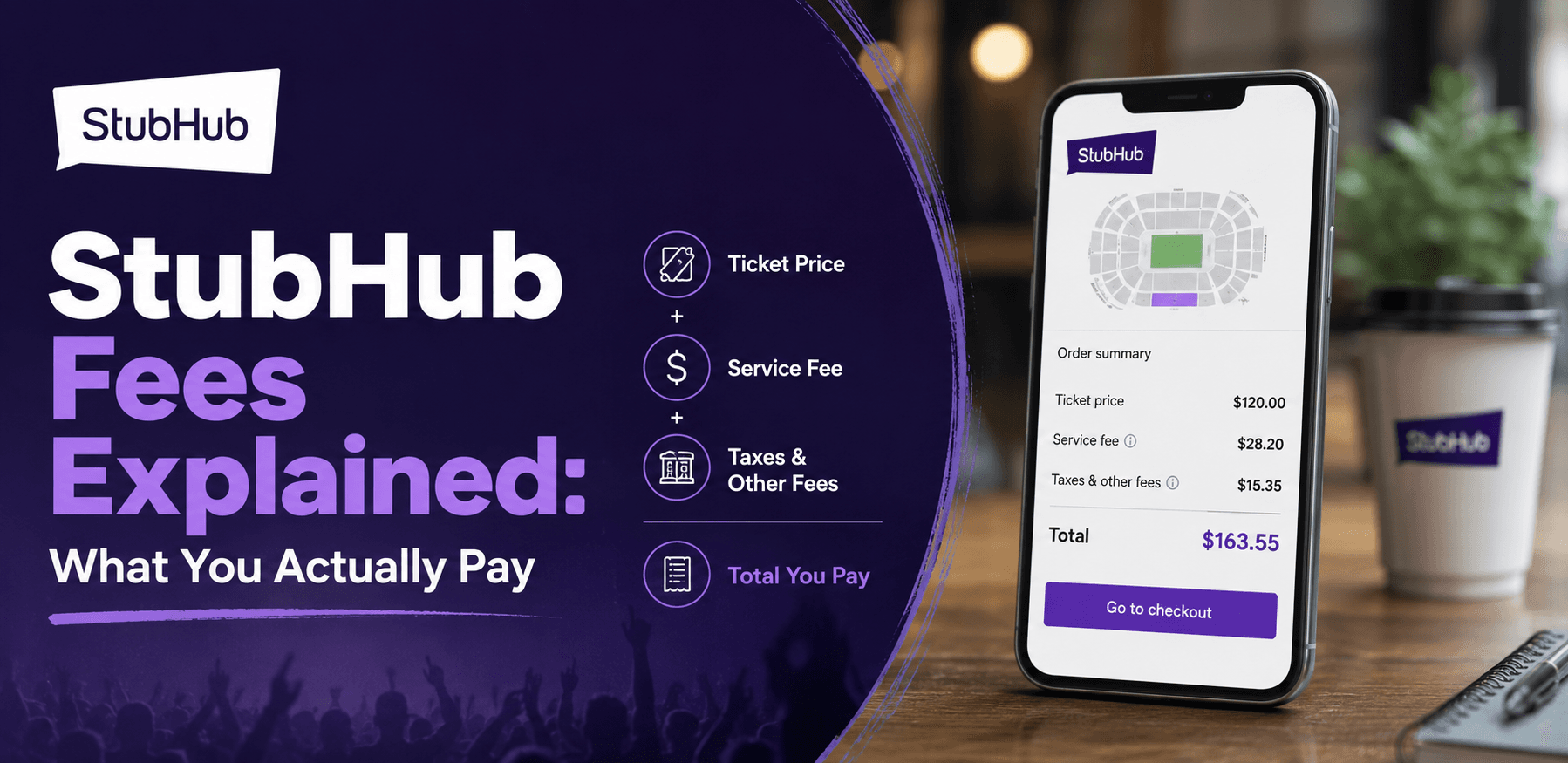
StubHub Fees Explained
May 05 2026
StubHub does not charge a fixed fee. Buyer fees are dynamic and average around 28% on top of the listed ticket price, and they can climb past 30 to 35% on high-demand events. Sellers pay a separate commission of about 15%. The number you see on the search page is the seller's asking price, not your total. Your real total shows up near the end of checkout.
Expect roughly 25 to 30% added to the sticker price as a buyer. Toggle the include-fees view before you browse, compare your final cart total against one no-fee site, and never buy in the last 24 to 48 hours if you can help it, because percentage-based fees ride the price up with demand.
What StubHub Fees Look Like in 2026
I buy tickets on StubHub two or three times a year, and the pattern holds. The listed price pulls you in, then a service fee and a fulfilment fee land at checkout. On a recent pair of seats listed at around $120 each, the added buyer fee worked out to roughly $67 across the order. That is the 28% range showing up in real money.
StubHub does not publish a fixed fee chart, and that is on purpose. The fee moves with the event, the seller, the demand level, and how close to event day you buy. Two listings for the same show, a few sections apart, can carry different fee totals because the fee scales with the ticket price.
The Fee Components: Line by Line
Your total breaks into a few parts. Not all of them go to StubHub, and that distinction matters when you decide whether a price is fair.
Charge | What it is | Rough size |
Service fee | The core platform fee is a percentage of the ticket price. Bigger ticket, bigger fee. | Most of the markup |
Fulfilment / delivery fee | Handling charge that varies by ticket type and delivery method. | Flat or small variable |
Taxes | State and local taxes are /added at the end. Not StubHub's fee, but part of your total. | Varies by location |
Combined, these push the typical buyer's total to about 28% over the listed price. In a playoff game or a sold-out tour, I have seen the effective rate sit higher because demand drags the percentage up with it.
Comparing first? Read our StubHub vs Vivid Seats breakdown
Why the Total Jumps Near the End of Checkout
This is the part that catches people. The practice is called drip pricing. You see a low starting number, you start the purchase, and the full cost only appears late in the flow. The fees are not secret. The timing of when StubHub shows them is what feels like a trap.
StubHub has gone back and forth on this. A few years ago, the company moved to all-in pricing under a no-surprise-fees banner. Since then, it has been tested, showing the lower number first again, with the full breakdown tucked behind a small Pricing details icon. The fix on your end is simple. Turn on the include-estimated-fees toggle before you browse so every listing shows the real total from the start.
Seller Fees: What StubHub Takes from Your Payout
If you are selling rather than buying, the math flips. StubHub charges sellers a commission of about 15% on the final sale price. List a pair for $200, and StubHub keeps roughly $30, leaving you $170 before any other deductions.
Listing is free. You only pay when the ticket sells. The practical move for sellers: decide the payout you want first, then reverse-calculate your list price so the 15% cut does not eat into your floor.
Worth knowing, StubHub earns on both sides of the same transaction. The buyer pays the service fee, and the seller pays the commission. That is normal for resale marketplaces, but it explains why the spread between what a seller nets and what a buyer pays can feel wide.
Check out Ticket Prices on StubHub
How StubHub Fees Compare to the Other Big Platforms
Fees are the main reason people compare resale sites, so here is the honest read from real transaction data rather than marketing copy. One analysis across platforms put the average total buyer fee on StubHub at about 27.76%, Vivid Seats at about 31.29%, and SeatGeek at about 37.66%.
Platform | Avg total buyer fee | Pricing style |
StubHub | ~27.76% | Drip, toggle for all-in |
Vivid Seats | ~31.29% | Drip at checkout |
SeatGeek | ~37.66% | All-in display, fee still baked in |
TickPick | 0% buyer fee | True all-in, listed price is the price |
StubHub is not the cheapest by default, and it is not the most expensive either. It sits in the middle of the pack on fees while carrying the deepest inventory pool in the US and the widest reach on international events. If your event is sold out everywhere, that inventory edge can matter more than a few percentage points.
Five Ways to Pay Less on StubHub
You cannot delete the fees. You can shrink your total. These are the moves that actually work, separated from the ones that do not.
Toggle include-fees before browsing. You will compare true totals instead of getting surprised at the cart.
Avoid the last 24 to 48 hours. Demand spikes late, and percentage fees climb with the price.
Check a promo or discount code first. A valid code can offset a real chunk of the service fee. Look before you check out.
Compare two sections. A small seat change can move the fee total because fees track price. Sometimes a row back saves more than the seat is worth.
Price-check one no-fee site. Pull up the same event and section on a zero-buyer-fee platform. If the all-in total is lower, buy there.
What does not work: Switching browsers, clearing cookies, or using a VPN does nothing. StubHub applies fees to every buyer regardless of device or location. Any blog claiming otherwise is guessing.
Is the FanProtect Guarantee Worth the Fee?
Part of what the service fee buys is the FanProtect guarantee. If your tickets do not arrive or are not valid at the gate, StubHub sources a comparable replacement first and refunds you if none exists. For a non-arrival, you typically file through the order page within the published deadline, often within 72 hours of the event.
For most buyers, this protection is the real reason to use a marketplace over a stranger on social media. The risk you are paying down is the small percentage of listings where a seller fails to deliver. Buying off a Craigslist post carries no such backstop. So the fee is not just markup. Some of it is insurance you will be glad to have on the one in fifty orders that go wrong.
FAQs
Does StubHub charge a buyer fee?
Yes. Every buyer pays a service fee plus a possible fulfilment fee on top of the listed ticket price. There is no fee-free purchase on StubHub. The total averages around 28% but varies by event and demand.
Why is StubHub's checkout total higher than the listed price?
The listed price is the seller's asking price. StubHub adds the buyer service fee and fulfilment fee at checkout, and state taxes apply at the end. Turn on the include-fees toggle to see the real total from the start.
How much does StubHub take from sellers?
StubHub charges sellers a commission of about 15% on the final sale price. Listing is free, and the fee is only deducted once the ticket sells.
Are StubHub fees higher than Vivid Seats or SeatGeek?
On average, StubHub fees run lower than both. Real-data averages put StubHub near 28%, Vivid Seats near 31%, and SeatGeek near 38%. The cheapest site for any single event still depends on the specific listing.
Can I avoid StubHub fees completely?
Not on StubHub itself. The only way to pay zero buyer fees is to use a true no-fee marketplace like TickPick, where the listed price is the total. On StubHub, you can reduce the total with codes and timing, but not remove the fee.