
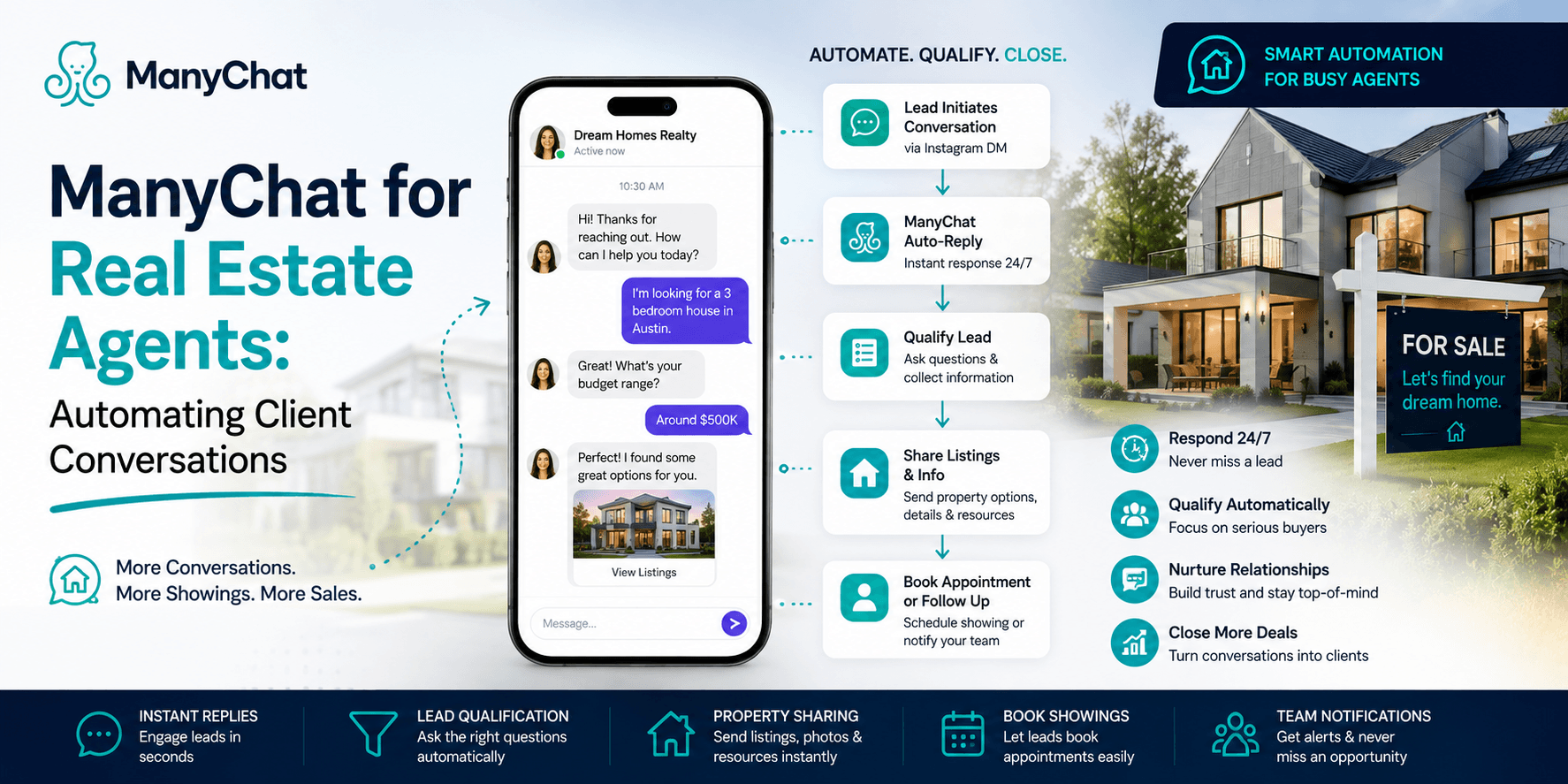
ManyChat for Real Estate Agents
Aug 25 2026
The average real estate agent takes 917 minutes — more than 15 hours — to respond to a new lead inquiry, according to Inman's 2025 response-time survey. In that same window, a buyer has usually already messaged two or three other agents. Real estate now has the highest chatbot adoption rate of any industry at 28%, and the response-time data explains exactly why: this is a category where the numbers make automation less of a nice-to-have and more of a competitive necessity.
The Data That Makes the Case
Before getting into setup, it's worth sitting with what the industry data actually shows, because it reframes what "automation" is solving for. It isn't primarily about saving an agent's time — it's about a measurable, quantified loss of business.
Statistic | Figure | Source |
Average industry lead response time | 917 minutes (15.3 hours) | Inman 2025 response-time survey |
Increase in lead qualification likelihood when responding within 5 minutes | 21x more likely | Industry lead-response research, 2026 |
Homebuyers who choose the agent who responds first | 78% | Real Estate Trainer data |
Agents who never follow up after the first contact | 48% | Spur 2026 lead qualification research |
Lead capture improvement from AI-assisted response systems | 40%+ | Inman/Real Trends Technology Adoption Survey, 2025 |
The 48% non-follow-up figure is arguably the more actionable one: nearly half of all real estate leads generated get zero second touch, not because the lead was unqualified, but because nobody followed a process. Automation solves the response-time problem and the follow-up problem in the same flow.
Where ManyChat Fits (and Where It Doesn't)
ManyChat automates Facebook Messenger, Instagram DMs, and WhatsApp conversations through Meta's approved APIs, using the same visual flow builder covered elsewhere in this series. For real estate specifically, it is not a purpose-built real estate CRM — it has no native MLS integration and no built-in property database — but it's genuinely effective as the response layer that sits in front of your existing content and routes qualified interest into whatever CRM you already use, typically via Zapier.
That distinction matters for how you should evaluate it: if your Instagram and Facebook content is already generating comments and DMs, ManyChat closes the gap between that engagement and an actual response. If your content isn't getting attention in the first place, automation has nothing to amplify — it fixes a response problem, not a traffic problem.
Six Flows Worth Building
Flow | Trigger | What It Does |
Listing Inquiry Auto-Reply | Comment or DM about a specific property | Sends photos, price, square footage, and a showing-booking link instantly |
Showing Request Flow | Lead wants to view a property | Buttons for time preference (weekday/weekend/evening), captures contact info, notifies you or your calendar tool |
Buyer Qualification Sequence | New lead enters the flow | 2-3 questions — budget range, financing status, timeline — tagging contacts by readiness |
New Listing Alerts | Contact opts in with criteria (location, price, bedrooms) | Automatically notifies matching contacts when a new listing goes live |
Open House Follow-Up | After an open house | Same-day check-in with buttons for interested / needs time / not a fit |
Seller Lead Capture | "What's my home worth" campaign response | Collects address, timeline, and reason for selling before routing to you for a call |
Automate Your Real Estate Leads
Step 1: Automate the Response, Not the Relationship
The highest-value first flow for most agents is the Listing Inquiry Auto-Reply, because it's the highest-volume, most repetitive question you get — "is this still available," "what's the price," "can I see it." Automating that single question typically closes more of the response-time gap than any other flow on this list.
Step 2: Qualify Before You Call
Add a short qualification sequence (financing status, timeline, budget range) between the initial response and your personal follow-up. Given that agents lose real time each week talking to leads who were never going to convert, tagging contacts by readiness before you pick up the phone means your calls go to people who are actually further along.
Step 3: Set a Hard Handoff Point
Automation should own the first response and the repetitive questions — not the negotiation, the tour, or anything emotionally significant. Buyers and sellers are making one of the largest financial decisions of their lives; they'll accept an instant automated first reply, but they expect and deserve a real person for everything past the initial qualification. Build a specific handoff trigger — a direct request, a qualifying answer, or a tag combination — where the flow stops and routes to you or your team.
Step 4: Connect It to Your CRM
Because ManyChat doesn't natively integrate with most real estate–specific CRMs, plan for a Zapier (or similar) connection from the start rather than treating it as an afterthought. Leads tagged by intent and budget inside ManyChat transfer that context into your CRM automatically, which means your team's first call already has the qualifying detail instead of just a name and number.
What Automation Won't Fix
If listings aren't getting comments or DMs in the first place, no amount of flow-building changes the top-of-funnel problem — automation only converts attention you're already generating. And a chatbot with generic, unspecific replies is worse than no automation at all in a category where trust is the entire product; every automated message should read as it came from a person who knows the market, not a script that could belong to any agent in any city.
Build Your Real Estate Chatbot
The Bottom Line
The math here is unusually direct for a marketing tactic: an industry that responds in 15+ hours on average, competing against buyers who choose whoever answers first 78% of the time, is a category where even an imperfect automated first response outperforms a perfect one that arrives a day late. Start with the single highest-volume repetitive question in your inbox, automate that first, and layer in qualification and follow-up once it's running cleanly.