How to Choose the Best Course on The Great Courses
Jan 11 2026
Have you ever scrolled through a streaming service, overwhelmed by the thousands of movies and shows, only to spend an hour deciding... absolutely nothing? Now, imagine that same overwhelming choice, but instead of entertainment, it’s knowledge. This is the exact challenge many lifelong learners face when they first open The Great Courses or its streaming home, Wondrium. With thousands of hours of lectures from the world’s leading professors, the problem isn’t finding a good course, it’s finding the best course for you right now.
In 2026, educational technology has advanced rapidly, but the timeless value of a masterfully crafted lecture remains. This guide will walk you through the precise steps to navigate this massive library, avoid decision fatigue, and choose the perfect intellectual adventure on The Great Courses.
What Makes "The Great Courses" Unique?
Before you choose, it’s essential to understand what you are choosing from. The landscape of online learning is vast. You have MasterClass for celebrity insights, Coursera for university credit, and Skillshare for practical, creative projects.
The Great Courses occupies a specific, premium niche: Academic Depth with Cinematic Production.
In 2026, the brand hasn't just maintained its standard; it has raised it. These aren't just taped lectures in a generic classroom. They are highly produced documentaries focused on deep subject matter. The professors are not just knowledgeable; they are the absolute top 1% of educators in their fields, hand-picked for their ability to tell a compelling story. When you choose a course here, you are choosing a comprehensive university-level exploration, but without the homework or the tuition.
Step-by-Step: How to Choose Your Ideal Course
Choosing the right course requires a blend of self-reflection and digital detective work. Follow this simple framework to find your perfect match.
Step 1: Define Your Learning Goal
Why are you here? Be honest. Your motivation will dictate which categories and professors will suit you best. Lifelong learners usually fall into one of three categories:
The "Grand Tour" Learner: You want a broad understanding of a major topic. You’re looking for a foundation.
Strategy: Focus on the "Foundations" or "Introduction to..." series, often 36–60 lectures long. Look for veteran professors like Daniel N. Robinson.
The "Deep Diver": You already know the basics and want to specialize in one narrow area.
Strategy: Skip the overviews. Look for highly specific titles like "The Black Death: The World’s Most Devastating Plague" or "The Life and Works of Beethoven." These are often shorter (12–24 lectures) but incredibly dense.
The "Skill-Builder": You want to apply what you learn immediately.
Strategy: Head straight to the "Better Living" or "Professional Development" categories. Look for courses like "How to Draw" or "The Art of Public Speaking."
Step 2: Start with the Category
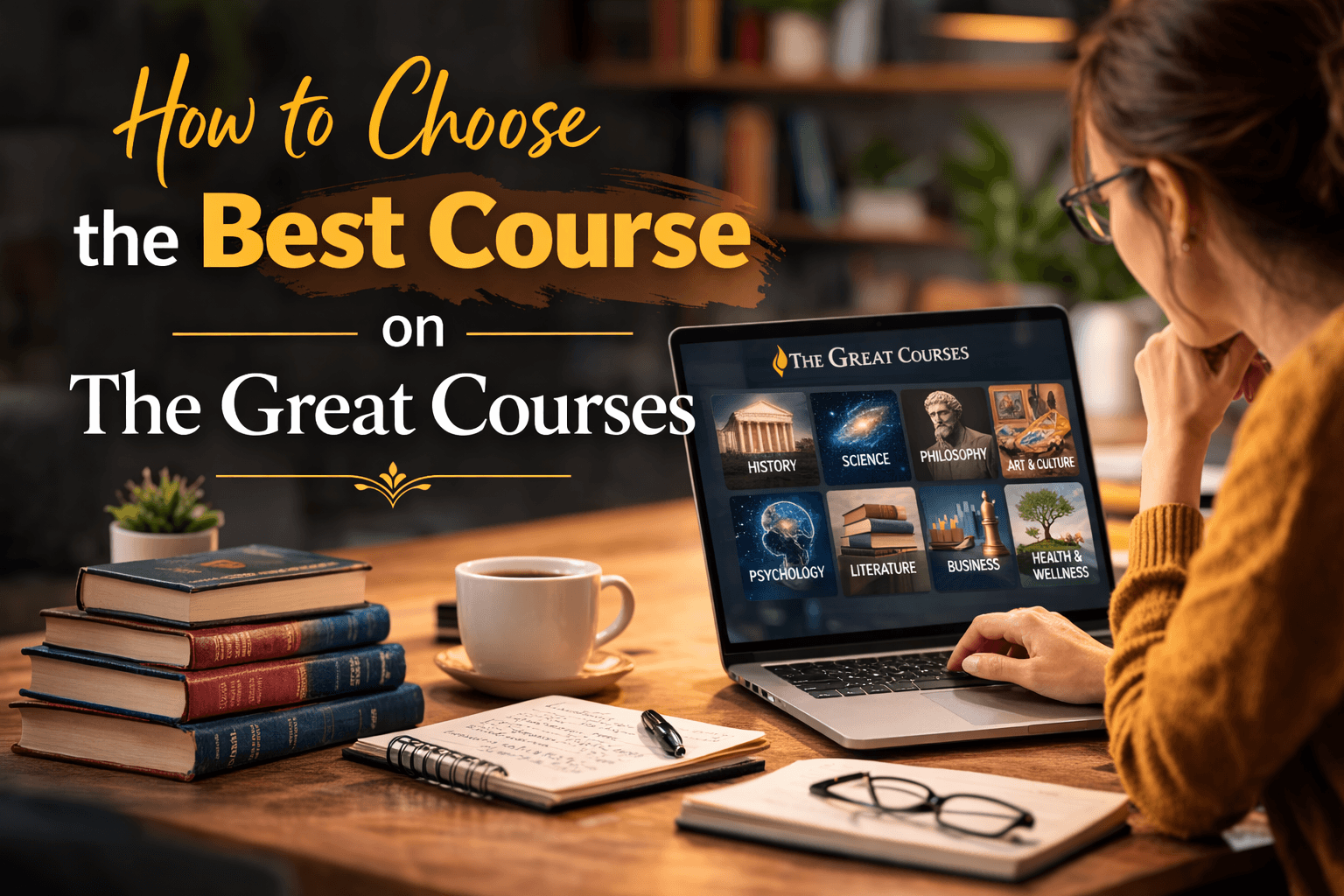
In 2026, most users access this content via Wondrium. The platform is organized into intuitive high-level categories. Start your search by selecting your primary interest:
Main Category | Popular Sub-Topics | Best For |
History | Ancient Rome, Civil War, World War II, European Royalty | The "Grand Tour" learner who loves a narrative. |
Science | Astrophysics, Cognitive Science, Geology, Quantum Mechanics | Curiosity-driven minds wanting to understand "how things work." |
Better Living | Cooking, Photography, Drawing, Public Speaking, Fitness | The "Skill-Builder" focused on tangible outcomes. |
Literature & Language | Shakespeare, English Grammar, The Odyssey, Great Authors | Book lovers and aspiring writers. |
Philosophy & Religion | Existentialism, Comparative Religion, Ethics, Logic | Deep thinkers exploring big life questions. |
Step 3: Evaluate the Professor (The Secret Sauce)
The subject is important, but the professor makes or breaks the experience. The Great Courses selection process is incredibly competitive, but every educator has a different style.
The Storyteller: Captivating, dramatic, and great at making historical figures feel real.
The Analyst: Highly logical, structured, and focused on arguments and data. Great for Science and Philosophy.
The Enthusiast: High energy, quick-paced, and infectious passion for their subject.
The Practitioner: Calm, clear, step-by-step guidance. Ideal for "Better Living" skills.
Before you commit, always watch the sample lecture or intro video. Is their voice soothing or grading? Do they use visual aids effectively? 20 minutes of auditing can save you 20 hours of frustration.
Step 4: Check the "Course Specifications"
A course title doesn't tell the whole story. Look closely at the digital details:
Course Length: Courses range from 6 short lectures to massive 60-lecture sets. Make sure the time commitment matches your current availability.
Guidebook Inclusion: Every great course should come with a PDF guidebook. This is a crucial feature in 2026, offering lecture summaries, reading lists, and discussion questions. Never choose a course without verifying the guidebook is included.
Audio-First vs. Video-Necessary: Some subjects (like Art History, Astronomy, or Drawing) are video-necessary. You must see the screen. Others (like Philosophy, History, or Economics) work perfectly in an audio-first format, ideal for commuting or multitasking. Wondrium now filters courses by "Audio-Friendly" status.
How to Use Reviews and Ratings
The most unique and valuable resource you have is the community.
The Wondrium Review Echo Chamber
On the Wondrium platform, ratings tend to be very high (4.5–5 stars). To find the real feedback, you need to read the comments, not just look at the stars. Look for patterns:
Red Flags: "Professor was monotonous," "Visuals were outdated," or "Subject was too basic."
Green Flags: "Professor’s passion was inspiring," "Learned something new in every lecture," or "Guidebook was excellent."
The "Audible Audit"
Many Great Courses are also available as audiobooks on Audible. Even if you plan to watch the video on Wondrium, checking the Audible reviews can be incredibly helpful. Audible users are often tougher critics of audio quality and pacing, offering a raw perspective you might not find elsewhere.
Avoiding Common Decision Pitfalls
Don't let these typical learning traps ruin your experience.
1: Starting with the Longest Course
It’s tempting to choose the 60-lecture "Great Ideas of Philosophy" as your first pick because it feels like the best value. However, this is the quickest way to get burnt out. Start with a 12 or 24-lecture course. Finish it. Get that sense of accomplishment, and then decide if you have the stamina for a 60-lecture marathon.
2: Ignoring Your True Interests
You might feel like you should learn about "The Economics of Healthcare," but if your heart really wants "The Secrets of Great Chocolate," choose the chocolate. Philosophy, science, and history will still be there later. Lifelong learning should be driven by joy, not obligation.
3: Assuming Older is Outdated
While Science and History are always evolving, many core subjects are timeless. A 15-year-old course on "The Works of Shakespeare" or "The History of Ancient Egypt" is just as relevant and valuable in 2026 as it was when it was filmed. Don't immediately dismiss a course just because the professor’s suit looks a bit out of style in the preview.
Conclusion: Start Your Journey Today
Choosing the best course on The Great Courses isn't about finding a universally perfect series, it’s about finding the subject and the storyteller that sparks your curiosity right now. By following this guide, defining your goals, auditing the professors, and starting small, you can eliminate decision fatigue and begin your 2026 intellectual adventure with confidence.
Frequently Asked Questions
What is the difference between The Great Courses and Wondrium?
The Great Courses is the name of the content library and the academic brand. Wondrium is the streaming platform and app where that library (plus additional documentaries and partner content) lives. In 2026, a Wondrium subscription gives you access to almost the entire Great Courses collection.
Which course is best for absolute beginners?
For an incredible introduction to deep learning, start with "The Big Questions of Philosophy" by Professor David K. Johnson. It focuses on specific problems (like "What is Truth?") rather than a chronological history, making it instantly engaging and relevant to daily life.
Can I get university credit for these courses?
No. While they are university-level in depth and taught by actual professors, The Great Courses are designed for personal enrichment, not for credit. If you need academic transcript credit, Coursera or edX are better options.
How often are new courses added?
In 2026, Wondrium adds several new "Great Courses" branded series every month, often focusing on timely subjects like emerging technology, current geopolitical history, or new scientific breakthroughs.