
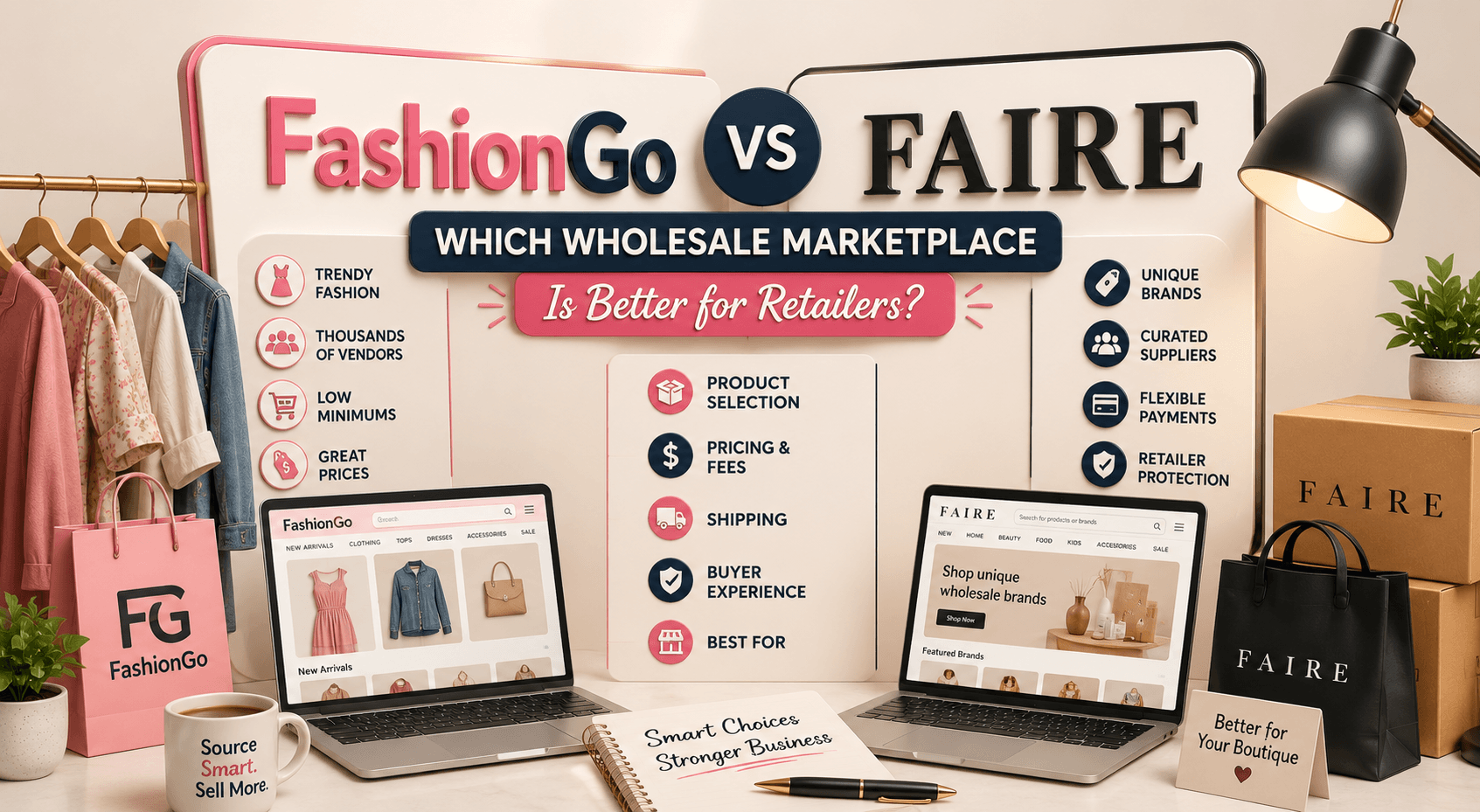
FashionGo Versus Faire Which Wholesale Marketplace Is Better For Retailers
Mar 11 2026
Finding dependable wholesale suppliers is one of the most important decisions a retailer can make. The marketplace you choose influences everything from product quality and pricing to inventory management and profit margins. Among the most popular B2B wholesale platforms available today are FashionGo and Faire.
Although both platforms connect retailers with wholesale suppliers, they serve slightly different purposes. FashionGo specialises in fashion-focused wholesale sourcing, while Faire offers a broader marketplace that includes fashion alongside home décor, gifts, beauty products, food, stationery, and lifestyle goods.
So, which platform is the better choice for your business?
In this guide, we'll compare FashionGo and Faire across product selection, pricing, vendor quality, shipping, ordering flexibility, and overall value to help you decide which marketplace best fits your retail needs.
FashionGo vs Faire: Quick Comparison
Feature | FashionGo | Faire |
Marketplace Focus | Fashion & apparel | Multi-category wholesale |
Best For | Clothing boutiques and fashion retailers | Boutiques, gift shops, lifestyle retailers |
Product Categories | Fashion, footwear, accessories, beauty | Fashion, home, gifts, food, beauty, stationery and more |
Wholesale Vendors | Thousands | Thousands |
Business Buyers Only | Yes | Yes |
Mobile App | Yes | Yes |
New Arrivals | Daily | Frequent |
Vendor Ratings | Yes | Yes |
Understanding the Difference
While both platforms operate as wholesale marketplaces, their strengths lie in different areas.
FashionGo is designed primarily for fashion retailers. If your business revolves around clothing, footwear, handbags, jewellery, or fashion accessories, you'll find a large selection of suppliers specialising in these categories.
Faire, on the other hand, is built for retailers who want to source products across multiple industries. In addition to fashion, retailers can shop for candles, home décor, kitchenware, greeting cards, wellness products, children's toys, gifts, and much more.
Your decision depends largely on what type of store you operate.
Product Selection
One of the biggest differences between the two platforms is the variety of products available.
FashionGo
FashionGo focuses heavily on:
Women's fashion
Men's apparel
Plus-size clothing
Footwear
Handbags
Jewellery
Activewear
Beauty products
Lifestyle accessories
Faire
Faire offers a much wider product catalogue that includes:
Fashion
Home décor
Gifts
Stationery
Beauty
Food and beverages
Baby products
Pet accessories
Kitchenware
Wellness products
Business Type | Better Choice |
Fashion Boutique | FashionGo |
Gift Shop | Faire |
Home Décor Store | Faire |
Clothing Retailer | FashionGo |
Lifestyle Store | Faire |
Mixed Retail Store | Faire |
Winner: It depends on your niche. Fashion-focused businesses generally benefit more from FashionGo, while retailers selling multiple product categories may find Faire more suitable.
Vendor Network
Both marketplaces work with thousands of wholesale suppliers, giving retailers access to a wide range of brands and products.
FashionGo's vendor network is centred around fashion manufacturers, distributors, and apparel wholesalers. This makes it easier for clothing retailers to compare similar products and discover new fashion trends.
Faire brings together independent brands from many industries, making it an attractive option for retailers who want to stock unique and handcrafted products alongside established wholesale lines.
Product Discovery
Finding the right products quickly can save retailers valuable time.
FashionGo Makes Discovery Easier Through
Fashion-focused categories
Trend-based collections
Seasonal arrivals
New vendor launches
Product filters
Faire Helps Retailers Discover
Independent brands
Curated collections
Trending products
Seasonal buying guides
New product launches
If your goal is to stay on top of fashion trends, FashionGo's specialised marketplace offers a more focused shopping experience.
Pricing and Wholesale Value
Wholesale pricing varies by vendor rather than by marketplace.
Both FashionGo and Faire allow suppliers to set their own prices, meaning you'll often find a range of options depending on the brand, order quantity, and product category.
Factors That Affect Pricing
Wholesale cost
Minimum order quantity
Shipping fees
Promotions
Seasonal discounts
Bulk purchasing opportunities
Instead of looking only at the product price, compare the total cost of sourcing, including delivery and minimum order requirements.
Minimum Order Requirements
Wholesale purchasing often involves minimum order quantities (MOQs), but requirements differ between suppliers.
Feature | FashionGo | Faire |
Vendor Sets MOQ | Yes | Yes |
Varies by Supplier | Yes | Yes |
Small Business Friendly | Yes | Yes |
Some vendors may accept smaller opening orders, while others require higher minimum purchases. Always check individual supplier requirements before ordering.
Shipping and Delivery
Fast and reliable delivery is essential for keeping your boutique stocked.
Both platforms provide shipping information directly through their vendors, including estimated dispatch times and delivery options.
Before placing an order, compare:
Shipping costs.
Delivery estimates.
Tracking availability.
Delivery regions.
Packaging quality.
Retailers who compare these details across suppliers are better positioned to avoid unexpected delays.
Ease of Finding Reliable Suppliers
Both marketplaces provide tools to help buyers evaluate suppliers before making a purchase.
Evaluation Tool | FashionGo | Faire |
Vendor Profiles | Yes | Yes |
Product Reviews | Yes | Yes |
Seller Ratings | Yes | Yes |
Product Images | Yes | Yes |
Business Information | Yes | Yes |
Reading reviews, checking ratings, and understanding return policies remain important regardless of which platform you choose.
Best Platform by Business Type
Business | Recommended Marketplace |
Women's Boutique | FashionGo |
Streetwear Store | FashionGo |
Footwear Retailer | FashionGo |
Gift Boutique | Faire |
Home Décor Store | Faire |
Lifestyle Shop | Faire |
Mixed Retail Store | Faire |
Fashion Accessories Boutique | FashionGo |
Choosing a marketplace that aligns with your inventory strategy makes sourcing much more efficient.
Pros and Cons
FashionGo
Pros
Fashion-focused marketplace.
Large selection of apparel suppliers.
Daily new arrivals.
Strong fashion trend coverage.
Excellent for boutique owners.
Cons
Limited non-fashion categories.
Less suitable for gift or home-focused retailers.
Faire
Pros
Wide range of product categories.
Large selection of independent brands.
Suitable for many types of retailers.
Strong product variety.
Cons
Fashion products compete with many other categories.
Clothing selection may not be as specialised as a fashion-only marketplace.
Which Marketplace Is Better for New Retailers?
If you're opening a boutique that specialises in clothing or fashion accessories, FashionGo often provides a more focused buying experience. You'll spend less time filtering unrelated products and more time discovering styles that match your target audience.
However, if your store plans to sell fashion alongside home décor, gifts, candles, stationery, or lifestyle products, Faire's broader catalogue can simplify sourcing by allowing you to purchase from multiple categories in one marketplace.
Neither platform is universally better, the right choice depends on your retail concept and inventory needs.
Final Comparison Score
Category | Winner |
Fashion Selection | FashionGo |
Product Variety | Faire |
Clothing Boutiques | FashionGo |
Gift & Lifestyle Retail | Faire |
Independent Brand Discovery | Faire |
Trend-Focused Buying | FashionGo |
Vendor Evaluation Tools | Tie |
Overall Flexibility | Faire |
Final Thoughts
Both FashionGo and Faire have earned strong reputations as wholesale marketplaces, but they cater to different retail needs. FashionGo shines as a specialised platform for apparel and fashion accessories, making it an excellent choice for boutiques that want access to a wide selection of clothing vendors and trend-driven collections. Faire, meanwhile, offers a broader marketplace that helps retailers source products across multiple categories from independent brands.
If fashion is the heart of your business, FashionGo is likely to be the more focused and efficient option. If you're building a lifestyle store with a diverse product range, Faire's wider catalogue may be the better fit. Many successful retailers even combine both platforms, using each where it performs best, to create a well-rounded inventory that keeps customers coming back.
Frequently Asked Questions
Is FashionGo only for fashion retailers?
FashionGo primarily focuses on fashion-related categories such as clothing, footwear, handbags, accessories, and beauty products. While some lifestyle items are available, it is best suited to apparel-based businesses.
Does Faire sell fashion products?
Yes. Faire offers fashion alongside many other wholesale categories, including home décor, gifts, stationery, wellness products, food, and beauty items.
Which platform is better for a clothing boutique?
FashionGo is generally the stronger choice for boutiques that specialise in fashion because its marketplace is dedicated to apparel and related accessories.
Can retailers use both FashionGo and Faire?
Absolutely. Many retailers source fashion inventory from FashionGo while using Faire to expand into complementary categories such as gifts, home décor, or lifestyle products.
Which marketplace offers more product variety?
Faire has a broader overall catalogue because it covers many retail categories beyond fashion. FashionGo, however, provides greater depth and variety within the fashion industry itself.