
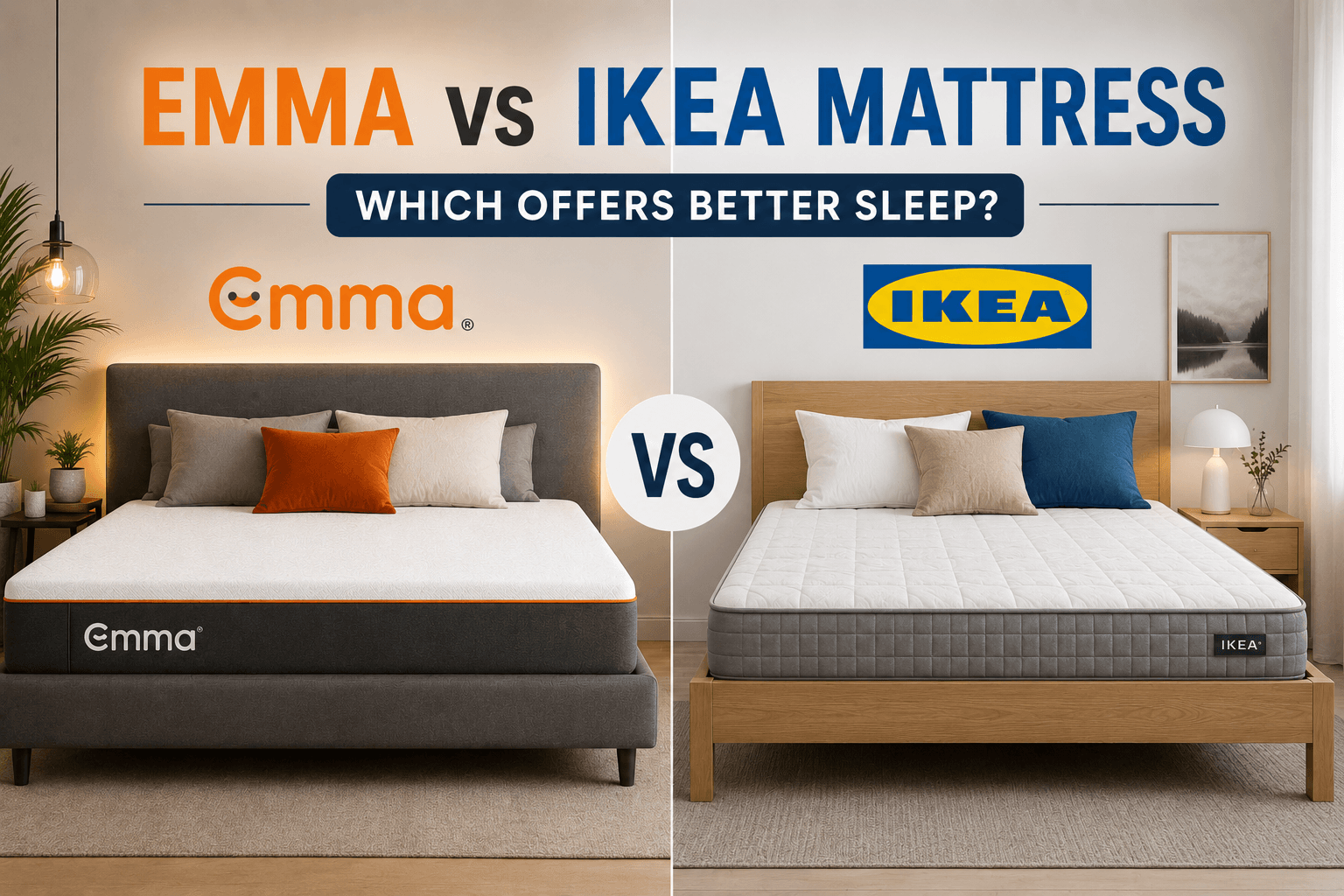
Emma vs IKEA Mattress Which Offers Better Sleep
Feb 23 2026
When it is time to replace an old, sagging bed, two major names frequently pop up for budget-conscious buyers: Emma and IKEA. Both brands offer highly accessible ways to upgrade your bedroom, but they approach sleep comfort in entirely different ways. IKEA is famous for its massive warehouses, flat-pack furniture, and highly affordable price tags. Emma, on the other hand, is a dedicated, award-winning sleep brand engineered in specialised research labs and delivered directly to your doorstep in a compact box.
If you are trying to decide between an Emma mattress and an IKEA mattress, this direct comparison will break down the key differences in materials, comfort, durability, and customer service so you can invest your money wisely.
Click here to find your perfect match and claim your exclusive discount on an Emma mattress today.
The Buying Experience: In-Store vs. Bed-in-a-Box
The first major difference between these two options is how you buy them.
The IKEA Experience
To buy an IKEA mattress, you usually drive to a giant store, walk through a crowded showroom, and lie down on a dozen different beds for 30 seconds each while wearing your shoes. Once you pick one, you have to load a heavy, awkward mattress into your car or pay extra for their third-party delivery service.
The Emma Experience
Emma is a pure online bed-in-a-box brand. You place your order from the comfort of your couch, and the mattress arrives at your front door rolled up and vacuum-sealed in a manageable cardboard box. It takes less than five minutes to unbox, and watching it expand to its full size is incredibly easy.
Material Quality and Structural Design
Let us look underneath the covers. The materials used inside a mattress dictate how long it will last and how well it will support your body.
IKEA Mattresses
IKEA offers a wide variety of mattresses, ranging from basic foam slabs to mid-tier pocket spring models. While they are highly affordable, IKEA typically uses lower-density foams and standard spring configurations to keep production costs down. This means their entry-level models can feel quite stiff, and they are generally more prone to sagging or developing body impressions within a few years of regular use.
Emma Mattresses
Emma focuses entirely on high-performance sleep technology. Even their standard models utilize proprietary materials like HALO memory foam for targeted pressure relief and Airgocell open-cell foam for heat dissipation. The materials are rigorously tested for up to 15,000 sleep cycles to ensure they retain their shape and support level for over a decade.
Shop the award-winning Emma Mattress lineup directly and skip the warehouse hassle.
Comfort, Firmness, and Support
How do they actually feel when you lie down at night?
Spinal Alignment: IKEA mattresses tend to lean toward the extremes—either very firm or notably soft. Finding a true orthopedic balance can be tricky. Emma mattresses are explicitly engineered for universal body support. They utilize zoned support systems, meaning the mattress is slightly softer around your shoulders to let them sink in, but firmer under your lower back to prevent sagging.
Temperature Regulation: Cheap foam beds trap heat, a common complaint among basic IKEA foam models. Emma counteracts this by using porous, breathable foam layers and hybrid models with built-in spring ventilation channels to keep you cool in all climates.
Motion Isolation: If you sleep with a partner, Emma easily wins this category. Its premium foam layers absorb vibrations completely. On many of IKEA's interconnected spring beds, you will likely feel your partner tossing and turning throughout the night.
Comparing the Fine Print: Warranties and Trials
A mattress is a long-term investment. Let us look at how both brands protect your purchase.
Feature | Emma Mattresses | IKEA Mattresses |
Home Sleep Trial | 100 Nights (Risk-Free, Full Cash Refund) | 90 Days (Exchange for another IKEA product only) |
Return Shipping | 100% Free home pickup | You must return it to the store yourself |
Warranty Length | 15-Year Manufacturer Warranty | 10-Year Limited Warranty |
Delivery | Free direct-to-door shipping | Paid delivery options |
The home trial is where Emma truly stands out. IKEA gives you 90 days to test a bed, but if you do not like it, they do not give your money back. They only allow you to exchange it for another IKEA mattress or an store credit note. Furthermore, you are responsible for transporting the mattress back to the store yourself.
Emma gives you a 100-night trial with a true cash-back guarantee. If you do not love it, they send a courier to pick it up from your house for free and return your money directly to your bank account.
Frequently Asked Questions
Can I get a cash refund if I don't like my IKEA mattress?
No. IKEA’s mattress return policy only allows you to exchange your mattress for another model or receive an store credit note within 90 days. They do not offer cash or credit card refunds for opened mattresses.
Do Emma mattresses fit standard European/IKEA bed frames?
Yes! Emma offers a full range of European sizes (like 140x200cm or 160x200cm) that fit perfectly onto IKEA bed frames without leaving gaps or hanging over the edges.
Which is better for back pain, Emma or IKEA?
Emma mattresses are generally better for back pain because they include advanced, zoned body mapping that keeps your spinal column in perfect alignment, whereas budget IKEA options often lack specialized orthopedic targeting.
How long does an Emma mattress last compared to an IKEA one?
Emma mattresses come with a 15-year warranty and use higher-density foams designed to resist sagging. Basic IKEA mattresses carry a 10-year warranty but typically show signs of wear and softening much sooner due to lower foam density.
Do not compromise on the quality of your rest.