
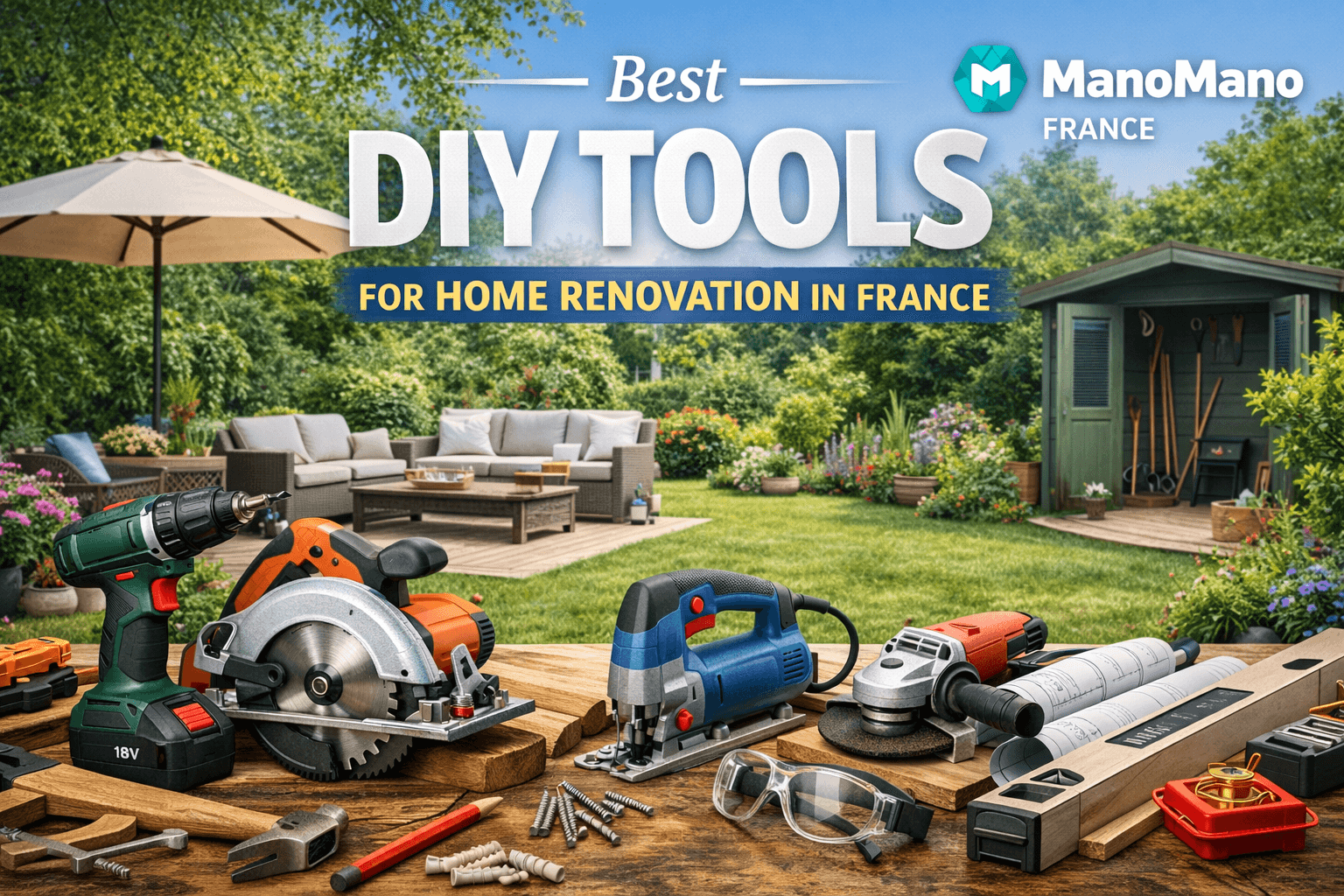
Best DIY Tools for Home Renovation
Jan 16 2026
If you’re renovating a home in France, whether it’s refreshing an apartment in Lyon, upgrading a kitchen in Bordeaux, or tackling a full house renovation in the countryside, the right outillage makes the difference between a weekend win and a month of frustration.
Best DIY Tools for Home Renovation in France
This guide focuses on DIY tools widely available on ManoMano, mapped to real renovation jobs (walls, floors, woodwork, plumbing, electrical, and finishing).
1) Cordless Drill/Driver (Perceuse Visseuse Sans Fil)
If you buy only one power tool for renovation, make it a cordless drill/driver. You’ll use it for:
Assembling kitchens and furniture
Fixing placo rails, hanging shelves, and curtain rods
Pre-drilling timber and fixing decking
Installing electrical boxes, cable trunking, and small hardware
On ManoMano France, you’ll find a huge choice in the “Perceuse visseuse devisseuse sans fil” category ranging from budget kits to pro-grade sets.
What to look for (France renovation reality):
18V platform if you plan to expand (drill + saw + sander later)
2 batteries minimum (so you’re not waiting mid-job)
Torque: 40–60 Nm is a sweet spot for most DIY renovation work
Hammer function (percussion) if you drill into masonry/brick occasionally
(For lots of concrete, see the rotary hammer section.)
Brands you’ll commonly find on ManoMano: Makita, Bosch, Einhell, and many others depending on deals and availability.
2) Impact Driver (Visseuse à Choc) — Fast Fix for Wood, Frames, and Screws
An impact driver is the “why didn’t I buy this sooner?” tool once you start:
Fixing large screws into timber (studs, joists, decking)
Driving lots of fasteners (kitchen carcasses, framing, cladding)
Working overhead or in awkward angles (it’s compact and powerful)
What to look for:
Brushless motor if you do frequent projects (better efficiency)
3-speed control for delicate vs heavy fastening
Bit holder quality + compatibility with standard bits
Tip: Many people in France buy the drill first, then add an impact driver on the same battery platform (Makita LXT, Bosch 18V, Einhell Power X-Change, etc.)
3) Oscillating Multi-Tool — Perfect for Deep Renovation
For renovation, an oscillating multi-tool is unbeatable for small, messy, precise jobs:
Cutting door frames for new flooring
Trimming skirting boards (plinths)
Removing old silicone, grout, and adhesive
Flush cuts in tight corners (where a saw won’t fit)
ManoMano’s multi-tool selection includes cordless and corded options, from budget to premium.
What to look for:
Tool-free blade change
Accessory ecosystem - blades for wood/metal, scraping, sanding pads)
Vibration control, if you’ll use it often (your hands will thank you)
4) Random Orbital Sander (Ponceuse Excentrique) — Smooth Walls & Doors
Renovation involves sanding always. A random orbital sander is ideal for:
Prepping doors, trims, stair parts
Smoothing wood filler and patchwork
Refinishing furniture
Sanding flat surfaces fast without deep swirl marks (when used properly)
ManoMano lists both DIY and pro models (including well-known pro lines).
What to look for:
125 mm or 150 mm discs (125 is most common and cheaper)
Dust extraction port (critical for indoor French renovations)
Variable speed for delicate finishes
Pro tip: Buy quality sanding discs. Cheap paper clogs fast and costs you more in time and frustration.
5) Plunge Saw (Scie Plongeante avec Rail) — For Kitchens, Panels, & Clean Cuts
If you’re fitting a kitchen, building wardrobes, or cutting large panels (MDF, plywood, worktops), a plunge saw with guide rail is a game-changer:
Straight, splinter-free cuts
Safer and cleaner than freehand circular saw cutting
Accurate for cabinetry and interior finishing
ManoMano has dedicated categories for plunge saws and plunge saw + rail searches.
What to look for:
Compatible guide rail system (some brands share standards, some don’t)
Depth capacity (around 55 mm covers most panel work)
Good dust port if cutting indoors
Quality blade for laminates/worktops (upgrade if needed)
If you’re doing only rough framing cuts, a standard circular saw may be enough. For interior precision: plunge saw wins.
6) Jigsaw (Scie Sauteuse) - Curves, Cutouts, and On-Site Flexibility
A jigsaw or Scie Sauteuse is still essential for:
Sink cutouts in worktops
Curved cuts in wood or laminate
Quick trimming where the plunge saw can’t fit
What to look for:
Pendulum action (faster cuts in wood)
Orbital/pendulum settings + variable speed
Blade quality matters (buy proper laminate/wood/metal blades)
7) Rotary Hammer (Perforateur SDS+) - For Concrete & Masonry
In many French buildings (especially older ones), you’ll face concrete, hard masonry, or thick stone. A standard hammer drill struggles. Enter the SDS+ rotary hammer:
Drilling anchor holes quickly
Light chiseling (tile removal, chasing channels—carefully)
Mounting heavy items securely
What to look for:
SDS+ chuck (standard for most renovation tasks)
3 modes: drill/hammer drill / chisel
Anti-vibration if you’ll use it a lot
Safety note: wall chasing or major structural work can be regulated or risky—when in doubt, consult a qualified artisan.
8) Angle Grinder (Meuleuse) - Cutting Metal, Stone, and Tiles
A 125 mm angle grinder is powerful for:
Cutting metal brackets, bolts, rebar
Trimming stone and masonry
Certain tile cuts with the right diamond disc
What to look for:
Tool-less guard adjustment and reliable safety switch
Disc compatibility (metal cutting, diamond for masonry)
Corded vs cordless: corded is often best value for grinding
Wear PPE: eye protection, gloves, and a proper dust mask—grinding dust is no joke.
9) Laser Level (Niveau Laser) - Straight Lines for Kitchens, Tiles, & Shelves
A cross-line laser level makes everything look professional:
Aligning kitchen cabinets and backsplash lines
Setting tile reference lines
Hanging shelves and frames perfectly
Aligning placo tracks and partitions
What to look for:
Self-leveling (automatic compensation)
Good visibility indoors (green beams are often easier to see)
Tripod compatibility and wall mount options
This is one of the best “time saved per euro spent” tools in home renovation.
10) Dust Management: Shop Vac (Aspirateur Chantier) + HEPA Bags
Renovation dust spreads everywhere, especially sanding dust and plasterboard (placo). A solid shop vacuum helps you:
Keep rooms livable during renovation
Improve tool performance (sandpaper lasts longer with extraction)
Reduce cleanup time massively
What to look for:
Wet/dry capability
Fine dust filtration (bags + filters)
Power tool socket (autostart) if you want a cleaner workflow
Even if you don’t buy a dedicated extractor, a good chantier vacuum is worth it.
11) Hand Tools You’ll Actually Use
Power tools get the hype, but these are the everyday heroes:
Tape measure (mètre ruban) + carpenter’s pencil
Set of screwdrivers and bits (PH/PZ/Torx are common in Europe)
Quality spirit level (niveau à bulle) even if you own a laser
Adjustable wrench + set of spanners
Utility knife + spare blades
Clamps (serre-joints) for gluing, holding, and cutting safely
Stud/pipe detector (détecteur de matériaux) for safer drilling in walls
When shopping on ManoMano, look for bundles (“coffrets”) for starter kits, but don’t compromise on the pieces you’ll use daily (tape measure, bits, clamps).
12) Job-Specific Tools for Common French Renovations
For painting & finishing
Good rollers/brushes matter more than people admit.
A paint sprayer can be great for doors/trim, but prep and masking time is real.
For plumbing refresh
Pipe cutters, PTFE tape, basin wrench, and a solid adjustable wrench go a long way.
For multicouche/PEX systems, make sure fittings/tools match your installation approach.
For tiling
A manual tile cutter + leveling system is often the best DIY combo.
What to Buy First (Smart Starter Kit)
If you’re building your renovation toolkit from scratch, prioritize in this order:
Perceuse visseuse sans fil (18V, 2 batteries)
Ponceuse excentrique + aspirateur chantier
Outil multifonction oscillant
Niveau laser
If you cut panels/worktops: scie plongeante + rail
If you drill masonry a lot: perforateur SDS+
This covers the majority of real renovation tasks in France: fixing, cutting, sanding, aligning, and drilling into tough walls.
Buying Tips on ManoMano France
Choose a battery ecosystem early (18V platform). It’s cheaper long-term than mixing brands with incompatible batteries.
Don’t overpay for power you won’t use: DIY-grade tools are fine for occasional jobs; step up to pro ranges for frequent renovation.
Invest in consumables: quality bits, blades, sanding discs, and dust bags often matter more than upgrading the tool.
Read reviews with your job in mind: “Great for assembling furniture” is different from “survived a full house renovation.”
Final Word: The Best DIY Tools Are the Ones That Match Your Renovation Plan
For home renovation in France, the “best DIY tools” aren’t one perfect list for everyone; they’re the right combination for your tasks: sanding and painting, kitchen fitting, tiling, placo, or heavy masonry. Use this guide to build a practical tool stack, available on ManoMano France, and aligned with real renovation workflows.
Also Read: Manomano Black Friday Sale